
Advanced Video Annotation Techniques to Train Next-Gen AI Vision Systems

For businesses building or scaling AI, the impact is huge. Applications like autonomous driving, surveillance, and medical imaging all rely on high-quality annotated video data. Without accurate Video Annotation Services, AI risks misinterpreting critical visual cues, leading to costly errors in performance, decision-making, or even user safety.
The challenge lies in the resource-heavy nature of frame-by-frame annotation. It requires time, expertise, and scalability that many in-house teams can’t sustain. This is why leveraging specialized video annotation services becomes essential, ensuring accuracy, efficiency, and the ability to scale complex AI projects.
7 Advanced Video Annotation Techniques Used Today
Each advanced technique enhances accuracy, scalability, and contextual intelligence, pushing video annotation beyond simple labeling. These methods ensure AI models not only see objects, but also understand environments, motion, and real-world complexity.
1. Active Learning–Driven Annotation
- What it is: AI models flag uncertain frames, and annotators prioritize only the most valuable samples.
- Why advanced: Reduces redundant labeling, accelerates dataset creation, and improves efficiency.
- Applications: Autonomous driving, surveillance, and large-scale video datasets.
2. Semi-Automated Annotation with AI Assistance
- What it is: Pre-trained AI suggests annotations, which humans refine.
- Why advanced: Balances automation and human oversight, cutting manual effort drastically.
- Applications: Retail video analytics, medical imaging, and sports analytics.
3. Temporal Consistency Techniques
- What it is: Algorithms ensure that annotations stay consistent across long video sequences.
- Why advanced: Reduces label drift and identity switches in object tracking.
- Applications: Pedestrian tracking, surveillance, and autonomous vehicle datasets.
4. 3D & Multi-View Annotation Fusion
- What it is: Combines multiple camera views or LiDAR + video to create enriched 3D annotations.
- Why advanced: Enables depth perception and better scene understanding.
- Applications: Robotics navigation, drone imaging, AR/VR.
5. Synthetic Video Data Augmentation
- What it is: Uses simulation or GANs to generate extra labeled video frames.
- Why advanced: Fills gaps in rare or hard-to-capture scenarios (night driving, accidents, unusualposes).
- Applications: Self-driving, rare medical conditions, defense AI.
6. Edge Case Annotation Frameworks
- What it is: Specialized workflows to capture difficult scenarios (occlusions, unusual lighting, partial visibility).
- Why advanced: Ensures AI models generalize well in real-world, unpredictable environments.
- Applications: Security monitoring, industrial inspection, healthcare imaging.
7. Cloud-Based Collaborative Annotation Pipelines
- What it is: Large distributed teams + real-time annotation platforms with integrated QA.
- Why advanced: Scales massive projects while ensuring accuracy through multiple checks.
- Applications: Enterprise AI training data at scale (autonomous fleets, global video datasets).
Together, these techniques elevate video annotation for machine learning from simple object labeling to strategic, AI-driven workflows that maximize speed, accuracy, and model performance.
Industry-Specific Use Cases for Video Annotation
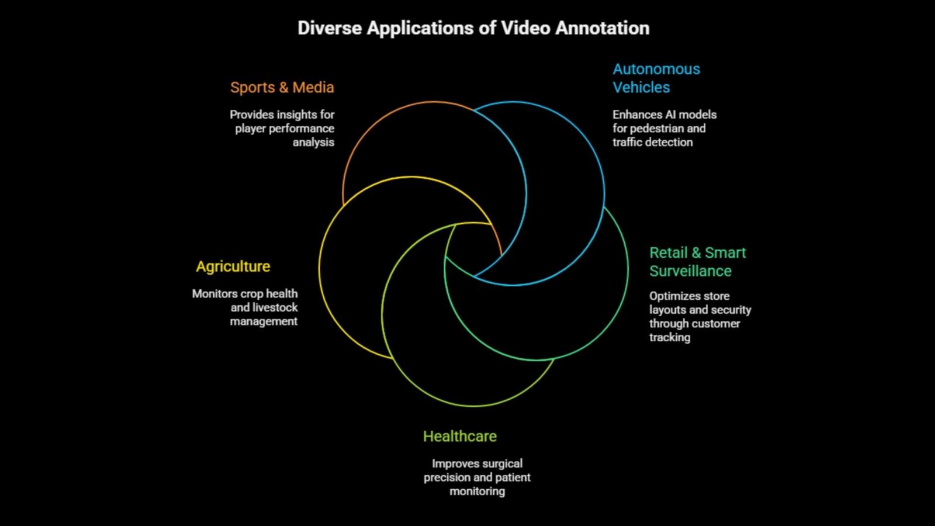
The power of an advanced video annotation service becomes most apparent when applied to real-world challenges across diverse industries. The tailored application of various annotation techniques allows businesses to unlock specific insights and drive innovation within their respective sectors.
Autonomous Vehicles
In the realm of Autonomous Vehicles, video annotation is foundational. Detailed annotations are used to train AI models for critical tasks such as pedestrian detection, enabling vehicles to identify and react to people on or near the road.
Similarly, precise labeling of vehicles, traffic lights, and road signs is crucial for comprehensive traffic behavior analysis, allowing self-driving cars to navigate complex urban environments safely and efficiently.
Retail & Smart Surveillance
For Retail & Smart Surveillance, video annotation provides invaluable data for optimizing store layouts, enhancing security, and understanding customer behavior. Annotations can track customer movement tracking patterns, identify popular product aisles, and even detect unusual activities, contributing to both operational efficiency and loss prevention.
Healthcare
In Healthcare, the precision of video annotation for machine learning is literally life-saving. It’s used to analyze intricate movements during surgical or patient motion analysis, helping to refine robotic surgical procedures, monitor rehabilitation progress, or detect early signs of neurological disorders.
Agriculture
Agriculture leverages video annotation to enhance crop yields and livestock management. Annotations of drone footage can monitor crop growth health, identify areas affected by disease, or track water levels. Similarly, tracking animal movement can provide insights into livestock health, grazing patterns, and overall welfare, leading to more efficient farming practices.
Sports & Media
Finally, in Sports & Media, video annotation transforms raw footage into actionable insights. It enables highly accurate player tracking for performance analysis, identifying tactics, and evaluating individual athlete contributions.
These examples underscore that an advanced video annotation service isn’t a one-size-fits-all solution, but rather a customizable tool that adapts to the specific demands and nuances of each industry, proving its indispensable role in modern AI development.
Common Challenges Solved by Experts
Expert video annotation services proactively tackle key challenges to ensure high-quality, reliable training data for computer vision:
Minimizing Data Bias – Balanced annotation prevents skewed datasets, ensuring fair and effective AI performance.
Reducing Label Drift – Multi-tier QA and skilled annotators maintain object identity consistently across thousands of frames.
Ensuring Consistency – Standardized guidelines, training, and inter-annotator checks eliminate variations across annotators.
Handling Edge Cases – Ambiguous or difficult scenarios (occlusion, poor lighting, odd angles) are meticulously labeled for better model generalization.
Managing Complex Scenes – Structured workflows enable accurate labeling of multiple classes (pedestrians, vehicles, signs, etc.) within the same frame.
Reliable Video Annotation Partner
Selecting the right video annotation service is less about hiring a vendor and more about choosing a strategic partner who can deliver high-quality, scalable data for your AI models.
- Proven Expertise: Look for partners skilled in bounding boxes, polygons, semantic segmentation, keypoints, 3D cuboids, and more.
- Scalable Infrastructure: Ensure they can handle data surges and work with leading platforms (CVAT, V7, Labelbox) or integrate with your custom tools.
- Rigorous QA: A mix of manual and automated checks, error detection, and inter-annotator agreement ensures frame-level accuracy.
- Domain Knowledge: Industry-specific teams (automotive, healthcare, retail) provide context-aware, high-precision annotations.
- Data Security: Verified compliance with NDAs, ISO 27001, and robust privacy safeguards.
- Smooth Delivery: Transparent onboarding, realistic timelines, and reliable communication throughout the project lifecycle.
The right partner guarantees not just annotations, but consistency, security, and accuracy—fueling the success of your computer vision initiatives.
Final Thoughts
In the intricate world of artificial intelligence, particularly in computer vision, video annotation isn’t merely a task – it’s the fundamental foundation upon which the success of your AI models is built. This specialized process involves meticulously tagging, labeling, and classifying objects and events within video footage to create a robust dataset for training machine learning algorithms. High-quality, precise, and scalable video annotation service is the difference between an AI system that merely exists and one that truly excels, driving innovation and delivering tangible business value. It’s the critical first step that transforms raw video data into a structured format that machines can understand and learn from, enabling applications ranging from autonomous vehicles and security surveillance to retail analytics and quality control.





It's free and takes 2 minutes. There are 1500+ digital agencies in the catalog that are ready to help in the implementation of your tasks. Choose and save up to 30% on time and budget!