
How is Artificial Intelligence Transforming Manufacturing Processes?
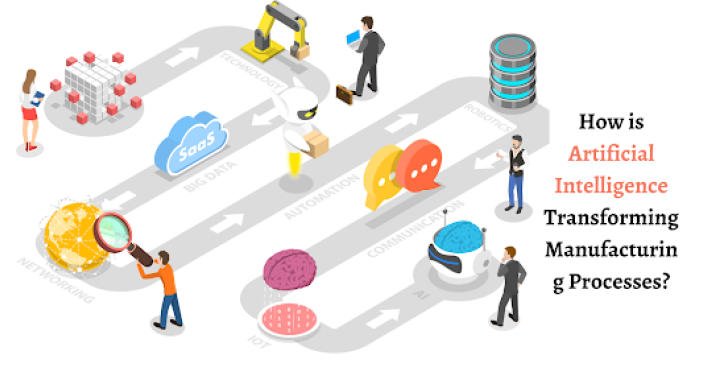
Artificial intelligence's transformational powers are converting the manufacturing sector. Large manufacturing businesses use AI to enrich productivity, accuracy, and efficacy in diverse operations. The application of AI in manufacturing encircles an expansive scope of use cases, including market forecasting, supply chain optimization, quality control, and predictive maintenance. It proposes a rebellious approach to conventional procedures. Adopting AI is now a strategic action for firms to contemporize operations and maintain an advantage in a competitive market.
According to a Deloitte survey, the manufacturing industry directs all other industries in data generation. This signifies that the manufacturing sector generates substantial data, which manufacturers must analyze using artificial intelligence (AI). Here, we will explore the consequence of artificial intelligence in the manufacturing industry and understand how it authorizes businesses to rise.
Influence of AI in the Manufacturing Industry
AI is paramount to the manufacturing sector's grinds to boost output, effectiveness, and decision-making abilities. By considering equipment data to foreknow potential failures, AI-driven predictive maintenance is used in production to improve maintenance schedules and decrease downtime.
Machine learning algorithms improve supply chain management efficiency by controlling inventories, estimating demand, and streamlining logistics. Robotics and AI make automation in assembly lines possible, improving speed and accuracy while adjusting to shifting production needs.
AI-powered quality control systems detect errors more precisely, ensuring consistency in the finished product. AI is also utilized in smart manufacturing to monitor operations in real-time and make quick modifications to optimize efficiency and minimize waste.
According to a PwC study, a subset of artificial intelligence called reinforcement learning can optimize the production of electrical devices by dynamically modifying machine parameters in intelligent manufacturing software development. Using ongoing learning and adjustment, the system optimizes output, reduces errors, and improves resource allocation, resulting in increased profitability and a competitive advantage.
AI transforms the production landscape by promoting creativity, reducing costs, and enhancing operational effectiveness. Using actual scenarios, let's examine some typical applications of AI in the manufacturing sector to better understand the technology's significance.
Use Cases for Artificial Intelligence in Revolutionizing the Manufacturing Space
Due to AI's integration, manufacturing is undergoing a paradigm transition, pushing the sector toward previously unheard-of breakthroughs and efficiencies. The top AI application cases in manufacturing and actual instances are listed here.
-
Supply Chain Management
Supply chain management is essential in manufacturing, and artificial intelligence has transformed the game. Enterprises are reinventing their supply chain processes and acquiring notable advancements in efficiency, accuracy, and cost-effectiveness by utilizing the potential of AI solutions for manufacturing.
Utilizing AI in the supply chain with the benefit of artificial intelligence development services providers makes it possible to improve demand forecasting, streamline logistics, optimize inventory management, and leverage predictive analytics. Machine learning algorithms can precisely examine past data, spot trends, and forecast demand variations.
-
Cobots
Collaborative robots, or cobots, are crucial to AI-driven manufacturing because they boost output by working alongside human operators. Cobots help pick up and pack at fulfillment facilities. These cobots and human workers use AI algorithms to detect items and navigate complex environments. For example, Amazon's cobots use machine learning to optimize operations, accelerate order fulfillment, and streamline logistics. These AI-powered robots are capable of accurately and adaptably completing complex tasks. Cobots can operate in unison with human workers to perform convoluted assembly procedures and quality control checks.
-
Assembly Line Optimization
Assembly line optimization utilizes AI to enhance industrial operations' accuracy, effectiveness, and adaptability. Machine learning algorithms enhance efficiency, decrease downtime, and enable predictive maintenance by evaluating historical performance measurements and real-time sensor data. AI-driven computer vision systems can spot defects or abnormalities to guarantee product quality. Intelligent automation reduces waste and maximizes resource use by altering production parameters in response to changes in demand.
How AI and Cloud Services Work Together to Drive Innovation in Manufacturing
As Artificial Intelligence continues to evolve, its integration into manufacturing processes is becoming more sophisticated, offering businesses incredible opportunities to optimize production, reduce downtime, and improve decision-making. However, the power of AI goes beyond just algorithms and models—it requires a robust infrastructure to scale effectively.
This is where cloud services companies come into play. By leveraging cloud platforms, manufacturers can access AI tools, storage solutions, and powerful computing capabilities without the need for expensive on-site infrastructure. Cloud services enable businesses to seamlessly implement AI-driven processes, ensuring real-time data analytics, predictive maintenance, and enhanced automation across operations. For manufacturers looking to accelerate their AI adoption and scale operations efficiently, partnering with a reliable cloud services provider can help unlock the full potential of these technologies.
Through scalable cloud solutions, businesses can quickly adapt to the demands of AI and stay competitive in the evolving market. Whether you're looking to incorporate AI into inventory management, supply chain optimization, or production scheduling, cloud services companies offer tailored solutions that help manufacturers thrive in this AI-driven landscape.
Conclusion
Many artificial intelligence applications in manufacturing demonstrate AI's crucial role in transforming different parts of the industry. Artificial intelligence AI has dramatically increased manufacturing processes' efficiency, accuracy, and cost-effectiveness in various areas, including supply chain management and predictive maintenance. To fully appreciate AI's influence in manufacturing, you will require the assistance of professional artificial intelligence development services.





It's free and takes 2 minutes. There are 1500+ digital agencies in the catalog that are ready to help in the implementation of your tasks. Choose and save up to 30% on time and budget!