
How to increase website conversion rates and sales

Low sales with good traffic? PPC company brings visitors but they don't stay on the site? It's time to work on your quality conversion rate, which measures the number of orders from the total number of visitors to your website.
We will tell you how to increase your conversion rate and avoid such troubles on your way to becoming an online business.
What is website conversion in simple terms?
The conversion of a website is the percentage of users who have taken a targeted action on a page of the website relative to the total number of visitors. Buy a product, register, call back or click on a link. In simple terms, it is the percentage of visitors who have become your customers or shown an interest in your product with a specific action.
Depending on the goals you and your business set, the target action, i.e., the conversion itself, will be determined. For example, for an online shop is a purchase or adding items to the shopping cart, for an information site - a subscription to the newsletter. The level of the user's willingness to become your customer differentiates the conversion into types:
- conversion to leads - cold (item comparison), warm (registration/authorization) and hot (adding an item to the shopping basket);
- conversion to customer/buyer - transaction and payment.
How to calculate website conversion rates
To get the calculations you need to measure the number of visitors over a given period and the number of targeted actions you are interested in. Google Analytics is a service that collects statistics to help you do this. Site conversion is calculated using the formula:

It should be noted that statistical services may fail to take into account some conversions. For example, when a user goes to the site, browses the product and immediately places an order over the phone, without making a purchase in the online shop. For more complete data collection it is better to use a call tracking system.
What is considered a normal conversion rate
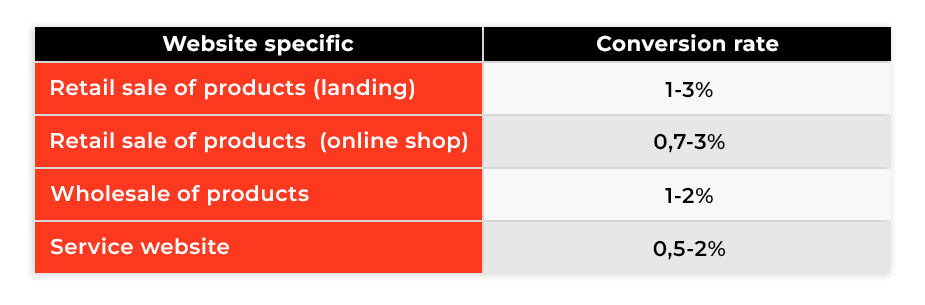
Don't listen to those who say 1% is the norm. For some niches an excellent conversion rate will be 0.5%, while for others 5% is extremely low. Everything is very individual here.
If we are talking about online shops, the most converting ones are those which sell unique products or have a strong USP. The level of competition plays a large role in this matter: the higher it is, the lower the conversion rate for each individual site.
Here are averages based on experience. Average conversion rate:
Which services can help you determine the conversion rate of your website
To measure conversions, you need to set up a full-fledged collection of statistics on user behavioural activity. The most effective free tools for this are offered by search engines.
Google Analytics
To use this tool you need to install a special statistics counter on your website. To track conversions choose the targeting actions which are most important for you, i.e. set goals. The variety of templates is one of the most important advantages of the service. It saves a lot of time when setting up.
What affects the conversion rate?
There are many factors that influence conversion rates to varying degrees. They can be both subjective (changeable) and objective (they cannot be influenced by the site owner).
The objective factors include:
- seasonal swings in demand;
- the need for a product / service;
- level of competition;
- type of product or service.
They all depend on the specifics of the business niche and the target audience. It is still possible to influence some of them, but it will take a lot of effort, time and resources.
Subjective factors:
- quality of the site;
- value of the product;
- the degree of interest of the visitors attracted;
- brand credibility and recognition.
The latter, in turn, are divided into internal and external. More about each type is below.
External factors
These are essentially how well you use your channels to attract traffic. The most interested users you manage to attract bring in an increase in conversion rates.
Given the peculiarities and diversity of methods of attracting customers on the web, it is normal to see a phenomenon where the conversion rate for different channels takes on non-identical values. For example, the most active visitors come from search for commercial queries. Those who click on info-queries are more interested in the content than in a purchase.
Internal factors
Internal factors are the quality of the website. It is attractive, user-friendly and informative. These include:
- design;
- content;
- usability of the interface and navigation;
- technical status;
- semantic core.
We'll tell you how you can use them to increase your conversion rate next.
How to increase your website's conversion rate
A selection of actionable techniques to help your website significantly increase conversion rates. Consider each group by type of factor.
Improving the technical characteristics of the site
If you can't see the problem, it's probably not that significant. This is misconception #1 when it comes to the technical side of your web resource that directly affects conversion rates.
Site page load speed
Don't wait too long. If the page opens too long, the user will leave without appreciating your efforts and efforts.
Guideline page load time - no more than 2 seconds. Normal considered a speed of 2-3 seconds. Anything more than that - it's already bad.
Google's helpful PageSpeed Insights tool can help you check page load speeds and make recommendations on how to improve your resource. Simply specify the URL and run the analysis. Note that all types of pages on your site are checked: main page, categories, subcategories, product pages, etc.
If the download speed indicators are in the green zone, the site has no problems. If in the yellow or red, it means that the service needs technical adjustments.

Use lead scrapers and subscription forms
Increase website conversion rates with lead scrapers, a relatively new web technology, that allows you to retain customers who are about to quit.
It works in the following way: if a visitor passes the mouse cursor to the upper right corner of a window (intending to close a tab), a modal window of this type will open in front of them:

In some cases it increases the conversion rate of traffic by 57-60%.
Subscribing to the site's newsletter works a little differently. It's simply a form that sits in a prominent place on the web resource. It invites visitors to leave an email address to receive emails with current news, promotions, and useful checklists and so on.
In return, offer a promo code for a discount, creating some sort of motivation. This will enable you to accumulate a large list of contact addresses for cold calling and email campaigns.
Design that inspires confidence and website usability
The look and feel of your website forms the visitor's initial impression of your online resource. If it is negative, the likelihood of the visitor moving to the next level of engagement in the sales funnel tends to be zero. You lose your potential customer before he or she realizes that the lowest prices, best delivery terms and courteous online service are all about you. Then all efforts are for naught.
If you want to increase conversion rates, make sure your site is engaging at first sight.
An important role is played by the colour design of the site, skillfully intertwined with the subject of your resource. For example, if this shop of children's goods, then warm beige colours he will do. However, these same colours should not be used in the online shop of military products.
An example of poor colour matching:

You must admit, that the colour scheme of a clothing shop is reminiscent of a construction company's website. In this case, the colours are not chosen correctly. Also pay attention to design elements (buttons, blocks, icons, etc.). Bulky look creates a sense of "heaviness" of the site.
In contrast, let us consider a design that is nearly ideal:

Here we see a very successful combination of blue and red hues. In the slider, the images echo the site's colour scheme. The design elements are well composed and not distracting. A special effect is given by the "cartoonish" logo. Overall, the design and its colour scheme are well suited to the subject matter.
Choose your fonts
Site font, text design and page element styling are essential components of a successful conversion strategy. When designing a web resource, you can save time and use standard settings and get a mediocre visual. Or make an effort and carefully work out the markup that the user will appreciate.
Speaking of the importance of creating styles, we mean working out absolutely all the elements, in particular:
- footnotes;
- references;
- lists labelling;
- heading design, etc.
Place emphasis on paragraphs, highlight headings. Focus on the readability of the text and how easy it is to read.
Quality content and live photos
High-quality text content is not just attractive letterpress styling, it's also a treasure trove of useful information for the user. Your content should hit the mark, sparking the reader's interest in your product and a desire to take a targeted action.
Just add a photo. Case study: A website increased conversion rates from product pages by 32% when more images were added.
Below is a bad example in which a product (in this case a smartphone model) has only one photo.

Wouldn't you, as a buyer, refuse to be able to assess the view of the product from all sides? Consequently, one photo is not enough.
And here's a good example of a product photo gallery implementation:

On the left we see a photo gallery with images of the smartphone from the back and side. What's more, it's possible to scroll through the phone in 3D.
The logic of buyers at this point is very simple, and it is a request for tactile contact with the product. To compensate for this disadvantage as much as possible, the moderators give maximum graphic and multimedia information on product pages. Then the customer gets a complete picture of the product he is interested in.
Testimonials and big name logos
How, who and what people say about you play a big role in the buyer's decision in your favour. Fill your website with the words of grateful customers and provide the opportunity to say "thank you" in a separate form.
It's best if it's not just reviews, but thank-you notes with actual photos of the authors, companies, positions. Your goal is to emphasizes expertise, relevance to big clients and recognizable brands.

A technique used by almost all commercial websites. Play on the mechanism: "If large companies order from this site, it means it is a quality and reliable resource, worthy of my attention".

It is very important to visualise the company logo, otherwise this block will have the opposite effect - distrust of the information presented.
Company certificates, awards and achievements
Don't be silent about your achievements. Talk about your business achievements and showcase your awards, certificates and licenses. Practice shows that visitors respond positively to such information. They seldom get into the nitty-gritty of it; the mere presence of regalia already gives them an edge over their competitors.

Individual certificates are also valid. Show that your team is qualified specialists, paying attention to the level of knowledge and growth in their niche.
How to increase conversion rates by optimizing sales elements of the site
Add a full technical description to product pages
This tip is particularly relevant for resources that sell technologically advanced products (with lots of technical specifications):
- electronics;
- home appliances;
- construction tools;
- watches, etc.
Here it is very important to understand the following axiom: product specifications are elements for comparison. A visitor targeting a choice (product, model, article number, etc.) has a set of criteria against which he or she is making a selection. If the product card doesn't provide any information from that list, the visitor will subconsciously assume that the product is absolutely not what he's looking for. This may not be the case at all.
Buttons with a call to action
Any site elements that prompt a visitor to take action need to be presented as buttons. Split testing of two types of graphic display call to action conducted by the internet marketing agency AWeber (USA) showed that buttons are 30% more effective than text links.
Here's an example of successfully implemented "Buy" and "Buy on credit" calls to action:

Work on pop-ups
A popup window, or PopUp, is one of the most controversial marketing tools. Some believe it helps the user to make a decision faster. Others, on the contrary, believe it only annoys visitors and gives them yet another reason to leave the site. The truth, as always, is somewhere in the middle.

Pop-ups work, they can collect audience contact details and eliminate choice paralysis, but that doesn't mean they're suitable for everyone. You can't be too hard on them. If such elements are present on the site, make sure that they are not the cause of low conversion. To do this, test by checking conversion rates currently, after eliminating PopUp windows and at different intervals/number of times they are displayed.
Add product benefits to the pages
Graphic elements, that are designed to convince the customer 100% that they're the right choice. Apply captions, icons and other auxiliary "perks". The goal is to convince the customer that there is no point in searching any further, because they have found what they are looking for.

Take care of delivery and payment
Give your customers a choice on how they want to receive their items and how they want to pay for them. Provide him with information about the cost of delivery, estimated period or the exact date of shipment, the additional terms (eg, "When ordering over 500 USD delivery for free"). Not everyone is ready to pay in advance, before the inspection of selected goods, and in this the buyer is right. "Pay as you go" - this statement should be one of the most important rules of your web resource.

Use distinctive technical triggers
This is a topic for a separate article, but we'll touch on it indirectly.
It's ideal if a marketing data analysis is carried out as early as the planning stage of an online shop. It is used to map out the personas that will make purchases on the website. These triggers are created already at the stage of designing the site.
Suppose there is a certain website that sells diesel generators. Now let's try to imagine the image of the buyer of these products. It is a middle-aged or older man who is primarily concerned with things:
- product specifications;
- quality;
- warranty period, etc.
In this context, the colour of the generator does not matter at all. It is much more likely that a diesel generator has a 24-month warranty, or that it has enough power to power an entire house, than that it comes in three colours.
If you understand your visitors' types, the use of triggers will greatly increase the conversion rate of your website.
Promotions and loyalty campaign
Loyal customers are the basis of a strong market position. Their number has a direct impact on conversion rates. Another effective way to increase sales is to gain a loyal audience.

Remarketing as a way to increase website conversion
In the pursuit of excellent conversion rates, test out remarketing tools. This is a type of interaction with users who have previously visited your site.
The customer comes to your shop, looks at your products, and in some cases even adds selected items to their shopping cart, but gets distracted by a question or change of mind and closes the tab. Your website's advertising then begins to follow it on other resources - member sites of the advertising network. "Perhaps it's a sign from above?" - the customer thinks, comes back to your site and takes a targeted action.
Remarketing allows you to target your advertising message directly to potential customers who have already been to your site. Its advantage is that it works for people who are initially interested in the offer.
Useful tools for increasing website conversions
You and I already know how to improve conversions by applying the metrics we've discussed, paying close attention to them. Let's look at additional tools that can help eliminate any disinterested user conversions, which means playing your part in the battle for conversion rates:
- A page that is relevant to the ad. Don't make false promises in your ads. By specifying the loudest "lowest prices", you will attract users who want to save money. If in fact the prices will not differ from the market, most visitors will leave without making an order.
- Accurately target your target audience segments. Segment your target audience. Considering the interests and peculiarities of each individual group makes it easier to select the most attractive offer.
- Use of keys with commercial intent. In search advertising, it is important to set up displays for queries that demonstrate a high degree of interest in the purchase. These may be commercial or general queries ("buy a summer dress", "legal services", "pizza delivery"), informational queries ("how to choose an air conditioner", etc.).
There are many more ways to increase the conversion rate of advertising traffic, but they are specific to each niche.
In summary
In this article, we have only touched on a small part of what internet marketing has to offer to increase conversions. It's a whole science with a variety of approaches. We hope that our recommendations will help you significantly increase the conversion rate of your websites.
If you still have questions about what is the conversion on the website, how to make it better in your specific case, feel free to contact us in any way convenient or you. We are delighted to help you!




It's free and takes 2 minutes. There are 1500+ digital agencies in the catalog that are ready to help in the implementation of your tasks. Choose and save up to 30% on time and budget!