
Why Local SEO is Thriving in the Age of AI-Powered Search

Artificial intelligence may dominate search, but local queries are still driving action. Learn practical steps to grow your local presence across platforms.
Generative AI is changing the way consumers search. Thanks to instant answers from AI Overviews, ChatGPT, and other tools, many users no longer need to navigate to websites, especially for informational queries.
But this change has led to a decline in click-through rates for many websites, despite an increase in views.
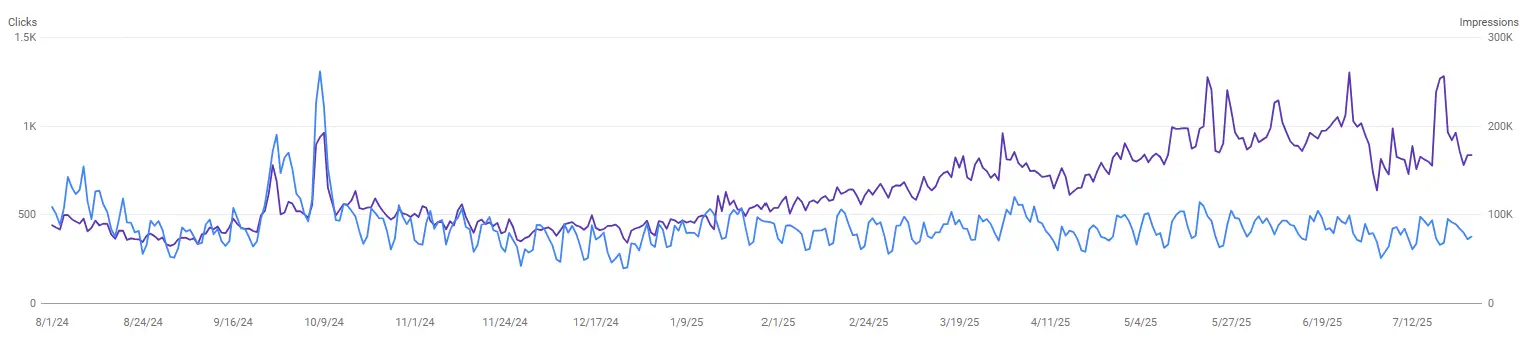
There is one notable exception, however: local search.
Businesses that rely on local queries see consistent results without the "alligator graph" (increasing views and decreasing clicks) that plagues other categories.
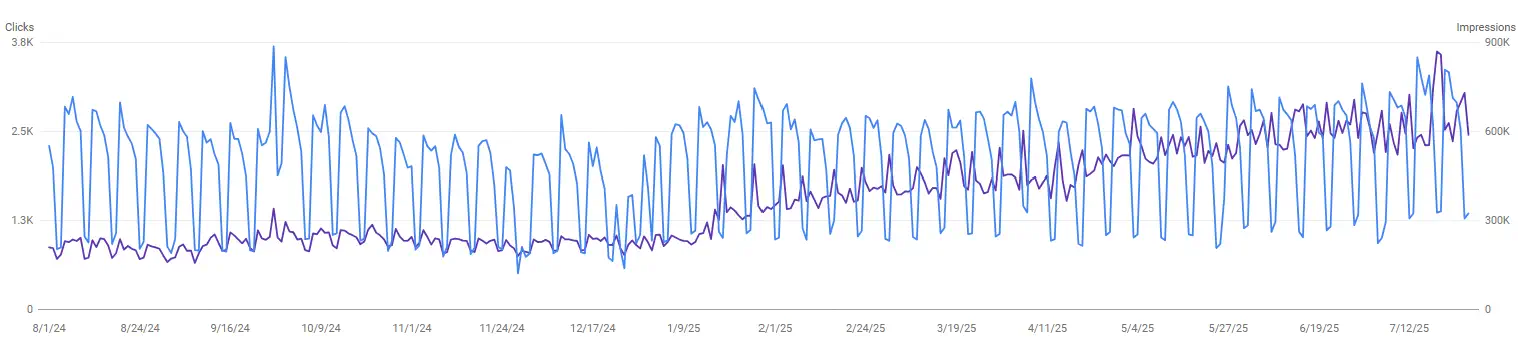
This article explains why local content is particularly resilient in the age of generative AI—and how you can take advantage of it. it, as a boost to your local SEO efforts.
1. Big language models don't provide good local search
Try typing [pizza near me] into ChatGPT or another AI platform.
The results will be vague, without images, and will often include places that aren't even nearby.

There are no maps, phone numbers, or real-time context.
Instead, try the same query in Google Maps.

You get a rich visual interface with accurate listings, reviews, directions, call buttons, and real-time location tracking.
AI tools don't offer comparable user experience for finding local properties. Why?
2. AI platforms lack reliable location recognition
Generative AI doesn’t know where you’re searching from—at least not unless you explicitly tell it. This lack of geolocation leads to generic, irrelevant answers.

For local search, proximity is a key ranking factor, so this is a critical weakness.
While privacy advocates may welcome anonymity, users searching for services nearby don’t benefit from the added hassle.
Most users don’t enter their exact address just to get AI-based suggestions. As a result, traditional search still wins for queries with clear local intent.
Even if AI tools eventually solve the problem of location accuracy, they still face another hurdle.
3. Local search implies real intent
Local search often leads to phone calls, in-person visits, or service appointments, not just website visits. Users want to talk to someone who can fix a roof, clean a pipe, or deliver a pizza. AI can explain how to do it, but it can’t do it itself.
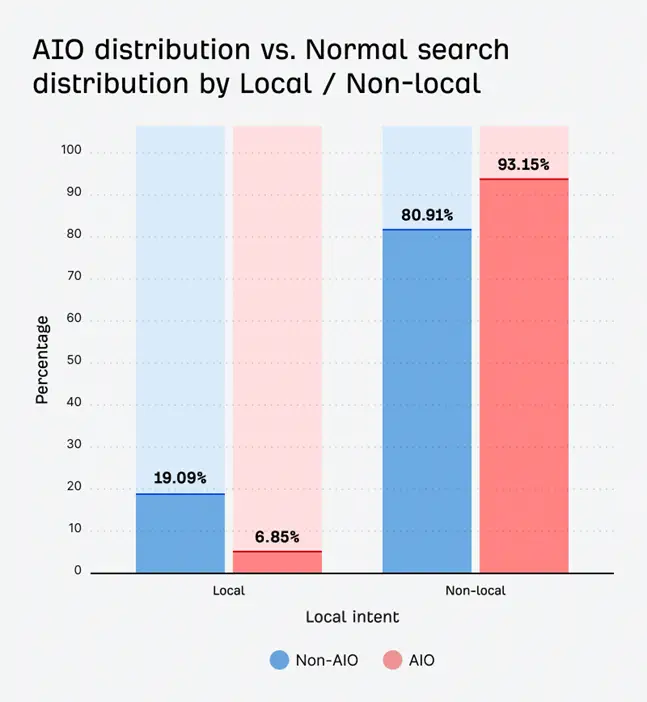
That’s why Google rarely includes AI reviews in local search results. In fact, according to a recent study by Ahrefs, AI reviews are less likely to appear for local queries than for informational queries.
Even when AI tries to answer, it relies largely on the same sources that traditional local SEO relies on.
4. AI results still rely on local data sources for SEO
Ask Perplexity or ChatGPT about a local service provider and you’ll often get:
- A “best of” list from Yelp
- Google Business Profile data, including number of reviews and ratings
- A link to Google Maps for directions
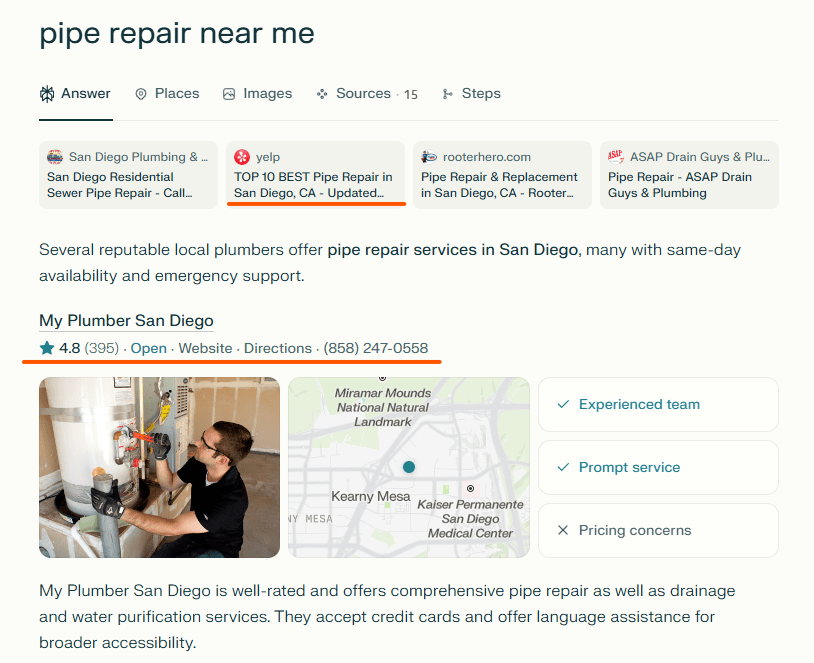
These models don’t generate original local knowledge. They aggregate and summarize structured data from platforms like Google, Yelp, TripAdvisor, and others.
As Lily Ray noted in a recent analysis, Google’s AI mode is much more likely to connect to Google business listings than to external websites.
This means that all the work on local listings, location pages, and service information pages will continue even if users decide to switch search platforms.
In short, all the basics of local SEO—reviews, directory listings, business listing accuracy—still matter. It could even be said that in the age of artificial intelligence, they matter even more.
5. Local SEO is built for a fragmented search future
As consumer search behavior evolves across platforms, it’s becoming increasingly important for businesses to be visible everywhere.
This is the foundation of search optimization everywhere.
Local SEO has always followed this approach. Success means having a presence on a vast network of data aggregators, mapping apps, industry directories, and review platforms.
It’s at these touchpoints that AI tools look for signals.
If your local business is consistently present on these platforms, you’re already responding to the way AI gathers and verifies information.
4 Practical Steps to Maximize Your Local Presence
To maintain and increase visibility in your local market, prioritize these tactical steps:
- Follow proven SEO tactics for mid- and bottom-of-the-funnel queries. AI in these areas is ineffective or nonexistent.
- Ensure consistency across all relevant local platforms. This includes your business name, address, phone number (NAP), hours, and categories.
- Fill out each local profile. Fill in all available fields and add rich content – photos, service descriptions, FAQs and menus.
- Continue to generate reviews. LLM programs depend on fresh, authentic, user-generated content. Regular reviews help your business stand out in AI-powered listings.
Key takeaway
Local SEO isn’t just surviving the transition to generative AI – it’s thriving. Investing in cross-platform visibility, accurate business data and review generation will remain relevant no matter how search evolves.





It's free and takes 2 minutes. There are 1500+ digital agencies in the catalog that are ready to help in the implementation of your tasks. Choose and save up to 30% on time and budget!