
Why Most Business Websites Fail to Generate Leads (And How to Fix It)
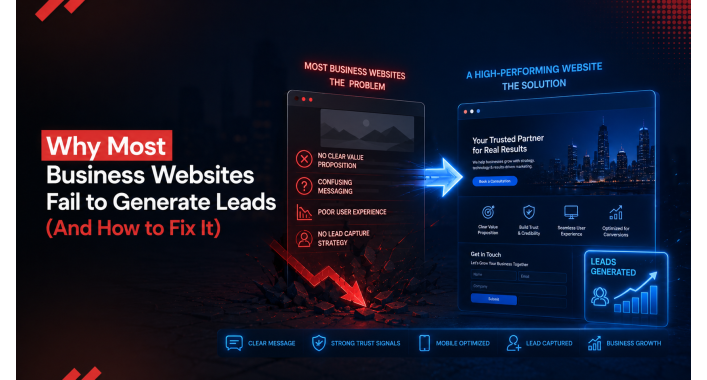
A business website is often treated as a milestone - something to launch, showcase, and move on from. In reality, it should function as a consistent lead engine. Yet many sites struggle to convert even when traffic is steady.
The problem is not visibility alone. It is a gap between interest and action. Modern website development must bridge that gap with clarity, structure, and intent-driven design. Without that, even the most visually appealing websites remain passive assets.
In this blog, we break down the underlying reasons business websites fail to convert and outline practical, high-impact fixes to transform them into consistent lead-generating assets.
The Core Problem: Websites Built for Presence - Not Performance
Most businesses invest in aesthetics - not outcomes. The result is a site that looks refined but lacks direction.
What typically goes wrong:
- Undefined messaging
Visitors cannot quickly understand what the business offers or who it serves
- Lack of direction
No clear user journey from landing to enquiry
- Fragmented content
Pages operate in isolation instead of guiding a cohesive experience
- Weak trust signals
Absence of proof, credibility markers, or real-world validation
- Poor usability
Slow loading, cluttered layouts, or non-intuitive navigation
These issues collectively create website conversion issues that silently reduce performance. Over time, this leads to a consistently low conversion rate - despite ongoing marketing efforts.
What Has Changed: The New Rules of Engagement
User behavior has evolved. So have search ecosystems. Search engines now prioritize:
- Depth and relevance over keyword repetition
- Content structured around real user intent
- Seamless, responsive experiences across devices
AI-powered search experiences are expanding how users discover and evaluate content. This means your website is no longer the first touchpoint - it is often the validation layer. Visitors arrive informed, comparative, and decisive.
Where Most Websites Lose Leads?
Not all pages contribute equally to conversion. In fact, a few key areas are responsible for most drop-offs.
- The Homepage: Too Broad to Convert
- Attempts to address multiple audiences at once
- Lacks a focused value proposition
- Overloads users with options instead of guiding them
- Service Pages: Informative but Not Persuasive
- Explain what is offered but not why it matters
- Missing differentiation and real outcomes
- Lack supporting proof or case-based context
- Contact Pages: High Friction, Low Motivation
- Generic forms with no context or reassurance
- No clarity on what happens after submission
- Feels transactional rather than conversational
- Landing Pages: Distracted by Design
- Too many navigation options
- Competing CTAs dilute focus
- Weak alignment with user intent
- Mobile Experience: Functionally Present, Strategically Weak
- Layouts shrink but usability suffers
- Forms are difficult to complete
- Interaction feels delayed or inconsistent
These gaps collectively undermine even the best traffic acquisition strategies.
The Fix: Building a Conversion-Oriented Website
Improving performance does not require a complete rebuild - it requires strategic recalibration.
- Start With Clarity - Not Brand Language
The biggest mistake businesses make is leading with how they want to be perceived, instead of what the user needs to understand. The website should not open with identity. It should open with utility.
Reframe your first impression:
- Define the exact problem you solve
- State the outcome in concrete terms
- Narrow your audience instead of broadening appeal
- Architect Pages Around Decisions-Not Information
Most websites are structured like brochures - layered with information but lacking direction. Users don’t need more content. They need clarity on what to do next.
Rebuild your page flow:
- Open with a relevant problem or trigger
- Introduce your solution with minimal friction
- Reinforce credibility before hesitation builds
- Present a decisive, low-effort next step
- Move Proof Closer to the Point of Doubt
Trust is often misplaced on websites - either hidden in a separate section or presented too late in the journey. That delay creates hesitation.
Upgrade your approach:
- Pair every major claim with supporting evidence
- Use concise case highlights instead of long-form testimonials
- Show before-and-after scenarios where possible
- Surface credibility within the user’s line of sight - not buried below
When proof is immediate, decisions feel safer and faster.
- Strip Away Anything That Slows Action
Most website conversion issues are not caused by missing elements - they’re caused by excess. Too many options, too much text, too many steps.
Audit for friction:
- Are users forced to think before acting?
- Are there competing CTAs on the same page?
- Does the form ask for more than it needs?
- Is navigation pulling users away from key actions?
Simplify aggressively:
- Reduce form fields to essentials
- Limit choices to one clear path
- Use direct, action-led microcopy
- Remove anything that doesn’t support conversion
Effective website optimization is about focus - not expansion.
- Redesign Mobile Experience Around Behavior-Not Layout
Mobile usage is no longer supplementary. For many users, it is the primary mode of interaction. Yet, a significant number of websites still treat mobile as an adaptation rather than a starting point. A more rigorous approach to responsive web development would include:
- Designing for touch interaction and ease of navigation
- Ensuring readability without effort
- Keeping key actions within immediate reach
- Maintaining performance consistency across devices
A compromised mobile experience signals a lack of attention to detail, which directly impacts user trust.
- Make Content Work as a Sales Layer
Visitors do not engage with content passively. They assess, compare, and evaluate. If your content does not support that process, it introduces uncertainty rather than clarity.
Content should:
- Address specific challenges faced by your audience
- Clarify how your solution works in practice
- Set realistic expectations
- Answer questions before they arise
This shift - from descriptive to decision-oriented content - is where custom website design and development become particularly valuable.
- Ensure Design Reinforces-Not Distracts
Design should serve a functional purpose. When it becomes overly expressive or inconsistent, it begins to interfere with usability.
Common issues include:
- Weak visual hierarchy that obscures key actions
- Overuse of design elements that compete for attention
- Inconsistent spacing that creates cognitive strain
A more effective design approach:
- Establish a clear visual flow that guides attention
- Use restraint to maintain focus on primary actions
- Ensure consistency across all pages
A capable web development agency understands that design is not an isolated discipline - it is integral to conversion.
- Treat Performance as a Competitive Advantage
Delays in interaction, even brief ones, can disrupt user intent - particularly at critical moments. It is widely observed that even a one-second delay in responsiveness can reduce conversions meaningfully.
Focus areas:
- Optimize loading speed across all devices
- Eliminate lag in buttons and forms
- Stabilize layout to prevent visual shifts
- Remove heavy, non-essential elements
Performance should be treated as a business concern - not solely a technical one.
- Build a System That Improves Over Time
Most websites decline because they remain static while user behavior evolves. High-performing businesses treat their website as a living system.
Establish a refinement loop:
- Track user journeys and drop-off points
- Analyze behavior across devices
- Test variations of key sections
- Iterate based on actual data
Without this, even the best-designed site will eventually suffer from a low conversion rate.
A Practical Audit Framework
Before implementing any changes, step back and evaluate your website development with a critical lens. Most performance issues are not isolated - they stem from deeper structural gaps.
-
Clarity
Can a first-time visitor immediately understand what you offer and who it’s for? If your messaging requires effort to interpret, it creates early drop-offs.
-
Direction
Does your website guide users toward a defined action, or does it leave them navigating aimlessly? Every page should contribute to a clear conversion path.
-
Trust
Are your claims supported by tangible proof? Without credible signals - such as results, client validation, or real examples - users hesitate.
-
Usability
Is the experience intuitive across devices? Navigation, readability, and interaction should feel seamless, particularly on mobile.
-
Performance
Does the site respond without delay? Slow load times or lag in interactions can disrupt momentum at critical moments.
-
Content Relevance
Does your content help users make a decision, or does it simply describe your business? Effective content reduces uncertainty.
If multiple areas fall short, the issue is structural - not cosmetic.
Emerging Trends Shaping Lead Generation Websites
Lead generation today is no longer driven by isolated tactics - it is shaped by how well a website aligns with evolving user expectations and decision-making behavior.
Intent-Led Content Architecture
The traditional keyword-first approach is losing relevance. What matters now is how effectively your content mirrors user intent at different stages of evaluation.
Modern websites are structured around:
- Problem awareness
- Solution comparison
- Decision validation
Content is no longer written to rank alone - it is designed to guide users through a logical progression. This shift is particularly important for any lead generation website development aiming to convert - not just attract.
Experience as a Competitive Advantage
Users are increasingly intolerant of friction. Speed, clarity, and ease of interaction now influence perception as much as brand credibility.
What sets high-performing websites apart:
- Immediate loading and smooth interaction
- Clear visual hierarchy
- Effortless navigation across devices
This is where responsive website development and thoughtful experience design move from being technical considerations to business-critical differentiators.
Connected Digital Ecosystems
Websites are no longer standalone platforms. They operate as part of a broader system that captures, processes, and nurtures leads.
A well-structured setup typically integrates:
- CRM platforms for lead management
- Analytics tools for behavior tracking
- Automation systems for follow-ups
This level of integration ensures that lead generation does not stop at form submission - it extends into structured engagement.
Continuous Refinement Over Static Launches
The most effective websites are never treated as finished products. They are:
- Monitored for user behavior
- Tested for performance improvements
- Refined based on real data
This ongoing process is central to website optimization, ensuring that performance improves over time rather than declines.
Closing Perspective
A high-performing site does not try to say everything. It focuses on what matters most - guiding the right visitor toward a clear action with minimum friction and maximum confidence. That means sharper messaging, stronger structure, and a deliberate approach to how users think and decide.
As search behavior continues to evolve and users rely more on quick answers and AI-assisted discovery, the margin for confusion is shrinking. Websites that win are the ones that communicate fast, prove value early, and make the next step effortless.
Ready for a website that drives growth - not just traffic? Connect with our experts today!





It's free and takes 2 minutes. There are 1500+ digital agencies in the catalog that are ready to help in the implementation of your tasks. Choose and save up to 30% on time and budget!