
AI Won't Replace Pastors. It'll Replace Burnout.
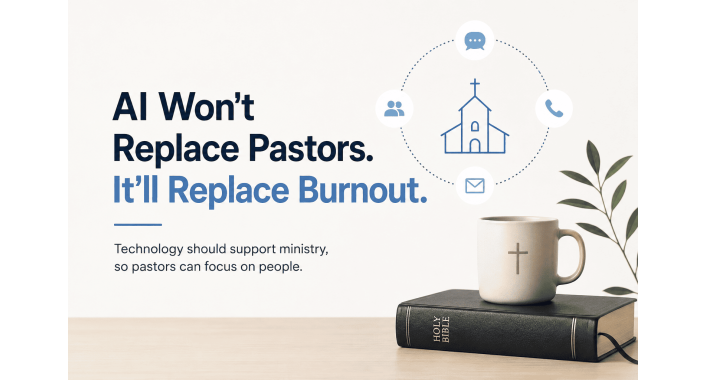
The bigger issue facing many churches is not whether AI will replace pastors. It is whether pastors and church staff can continue carrying an ever-growing list of responsibilities without burning out.
Today, ministry leaders are expected to be spiritual shepherds, counselors, administrators, communicators, event planners, marketers, and sometimes even IT support. They answer emails, return phone calls, manage follow-ups, coordinate volunteers, prepare sermons, and respond to people at all hours.
AI will not replace the calling of a pastor.
But it can help replace the repetitive work that is quietly exhausting them.
The Real Crisis Isn't AI. It's Ministry Burnout.
Pastoral work has never been a simple job. Unlike many professions, ministry does not always end at 5 p.m.
A church member may call late at night. A family may need urgent support. A first-time visitor may have questions on a Saturday evening. Someone struggling with grief may send a message when the church office is closed.
At the same time, pastors still have sermons to prepare, teams to lead, meetings to attend, and families of their own to care for.
The result is often a dangerous cycle: more responsibilities, less time, and eventually, less emotional and spiritual capacity.
This is where technology can become an ally rather than a threat.
Consider something as simple as the church phone.
When someone calls a church and nobody answers, the opportunity may disappear. Yet expecting pastors or staff members to be available around the clock is not sustainable. This is why many churches are beginning to explore the best answering service for churches, not to remove human connection, but to ensure people are heard when staff members cannot immediately respond.
An AI-powered answering service can answer common questions, provide service information, capture contact details, route urgent needs, and help ensure that important calls do not simply go to voicemail.
That is not replacing ministry.
That is protecting the people doing ministry.
AI Should Handle Tasks. Pastors Should Handle People.
The best way to understand AI in the church is to separate administrative work from pastoral work.
AI is exceptionally useful when a task is repetitive, predictable, or time-consuming.
For example, AI can help churches:
- Answer frequently asked questions
- Respond to common website inquiries
- Capture and organize visitor information
- Route phone calls and messages
- Send reminders and follow-up communications
- Help draft routine emails and announcements
- Summarize meetings and administrative notes
- Organize internal information
- Provide staff with quick access to resources and policies
- Support communication workflows outside office hours
None of these responsibilities require AI to replace a pastor's calling.
Instead, they reduce the number of small tasks competing for a pastor's attention.
Think about how much time is lost every week answering the same questions:
What time is Sunday service?
Where do I park?
Do you have a children's ministry?
How can I request prayer?
Who should I contact about counseling?
These questions matter. People deserve answers.
But they do not always require the senior pastor to personally provide them.
When AI handles routine communication, church leaders can spend more time doing what technology cannot truly replicate: building trust, offering wisdom, listening with empathy, and providing meaningful spiritual leadership.
The Goal Isn't Automation for Automation's Sake
Churches should not adopt AI simply because it is trendy.
The real question should be:
What is preventing our people from focusing on the work only people can do?
If a staff member spends hours manually responding to repetitive messages, AI may help.
If visitors repeatedly reach voicemail after office hours, AI may help.
If important follow-up requests are being missed because information is scattered across different systems, AI may help.
The value of AI is not in replacing people. Its value is in removing friction.
Church leaders should think of AI as an additional layer of operational support.
A good AI system does not need to make every decision. It can gather information, answer basic questions, organize requests, and alert the right person when human intervention is needed.
That creates a healthier balance between automation and human connection.
What Happens When Churches Don't Address the Workload?
The risk of ignoring AI is not necessarily that every church will suddenly fall behind technologically.
The bigger risk is continuing to operate with systems that place unnecessary pressure on already stretched teams.
Churches often talk about protecting their pastors from burnout. But protection requires more than encouraging leaders to take a vacation.
It also requires examining the systems creating the overload.
If pastors are manually doing work that could be assisted by technology, then the church may be unintentionally wasting one of its most valuable resources: human attention.
Every hour spent sorting routine inquiries is an hour that could have been spent discipling someone.
Every missed phone call could represent someone searching for help.
Every repetitive administrative task contributes to the invisible workload that many ministry leaders carry.
This is where digital pastoral agents can play an important role.
Digital pastoral agents are not designed to replace spiritual leadership or impersonate a pastor. Instead, they can act as intelligent support systems that help churches manage communication, information, and routine interactions at scale.
For example, a digital pastoral agent could help answer questions about service times, ministries, events, next steps, or available resources. It could collect a prayer request and ensure it reaches the appropriate team. It could assist a visitor who wants information outside normal office hours.
The important distinction is this: AI can support the ministry journey without replacing the human relationship.
A person experiencing a crisis may initially interact with an AI-powered system, but the system should know when to escalate the situation to a qualified human.
That is the future of responsible church AI: not human replacement, but intelligent support and appropriate handoff.
The Most Human Churches May Become the Best Users of AI
There is an irony in the fear surrounding AI.
Some people assume that more technology automatically makes an organization less personal.
But when used correctly, AI can actually create more space for human connection.
Imagine a church where routine questions are answered instantly, visitor inquiries are captured consistently, follow-ups do not get forgotten, and staff members are not overwhelmed by repetitive communication.
The result is not necessarily a colder church.
It may be a more responsive one.
The key is implementation.
Churches should never automate everything blindly. They should identify the tasks that drain time without requiring deep human judgment and automate those first.
A healthy model looks something like this:
AI handles repetition.
People handle relationships.
AI organizes information.
Church leaders provide wisdom and discernment.
AI responds instantly when appropriate.
Humans step in when empathy, care, or pastoral judgment is required.
This approach allows technology to strengthen ministry operations without confusing automation with ministry itself.
AI Is Not the Shepherd. It's the Support System.
No algorithm can replace the trust built through years of ministry.
AI cannot stand beside a grieving family in the same meaningful way a pastor can. It cannot carry the full responsibility of spiritual discernment, moral leadership, or authentic community.
And it should not try to.
But pastors should not have to spend their calling answering the same administrative questions hundreds of times either.
The churches that benefit most from AI will likely be the ones that understand its limits.
They will not use AI to eliminate human ministry.
They will use it to eliminate unnecessary friction around human ministry.
The future of church leadership is not pastors versus AI.
It is pastors supported by better systems.
It is church teams spending less time buried in repetitive work and more time with people.
It is visitors receiving answers when they need them instead of encountering silence.
And ultimately, it is technology being used for what it does best so people can focus on what only people can do.
AI won't replace pastors.
But if churches use it wisely, it may help replace something ministry leaders have been fighting for far too long:
Burnout.




It's free and takes 2 minutes. There are 1500+ digital agencies in the catalog that are ready to help in the implementation of your tasks. Choose and save up to 30% on time and budget!