
How to Tell If Text Was Written by AI: A 2026 Guide to Content Detection
AI writing tools are now part of everyday work, which means the opposite skill has become just as valuable: knowing whether a piece of text was written by a person or generated by a model. Teachers, editors, recruiters, and publishers all face the same question, and guessing by "gut feeling" is no longer reliable — modern models write fluently enough to pass a casual read.
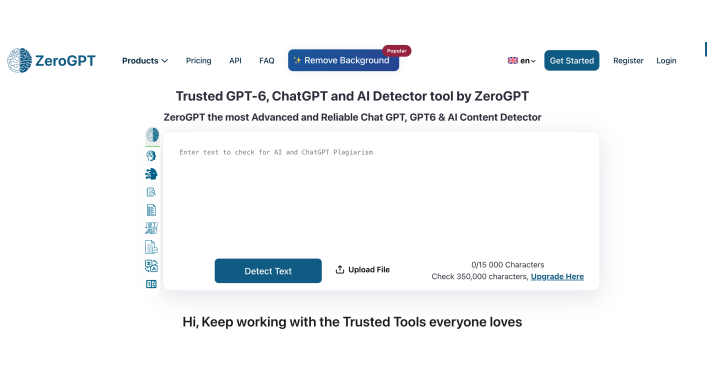
That is where detection tools come in. Instead of judging style by eye, they measure statistical patterns in the writing itself. If you want to check AI involvement in a document, a tool like ZeroGPT scans the text, returns a percentage estimate, and highlights the sentences that look machine-generated — turning a vague suspicion into something you can actually review line by line.
What AI Detectors Actually Measure
AI detectors do not "understand" meaning — they measure how predictable the writing is. Human writing tends to be uneven, with surprising word choices and varied sentence lengths. Generated text, by contrast, often picks the safest next word again and again, producing a smooth but statistically flat pattern.
Perplexity and burstiness
Two signals do most of the work. Perplexity measures how "surprised" a language model is by the next word — low perplexity means every choice was the obvious one, a hallmark of generated text. Burstiness measures variation across sentences; humans mix short and long sentences unpredictably, while models tend to even things out. Together these give a strong statistical fingerprint.
Why it catches unseen models
Because detection is based on statistical properties rather than memorized samples, a good detector can flag text from models it has never been trained on, and even output from paraphrasing or "humanizer" tools that rewrite AI drafts. That is why these checkers stay useful as new models appear.
What to Look For in a Detector
Detectors vary widely in quality. When choosing one, compare them on the things that matter in real use:
- sentence-level highlighting, so you can see exactly which parts look generated;
- a clear probability score rather than a vague "AI / not AI" label;
- support for the languages you actually work in — accuracy is highest in English;
- batch uploads and exportable reports if you review volume for a team;
- free access for quick checks, without forcing an account.
A tool that offers these — ZeroGPT, for example, reports sentence-level results and a percentage gauge — gives you something reviewable, not just a verdict to take on faith.
How Accurate Is AI Detection?
Leading detectors report accuracy figures in the high nineties on their own benchmarks, and sentence-level checking has improved markedly. But a headline accuracy number is not a guarantee for any single document. Short texts, heavily edited drafts, and mixed human-plus-AI writing are the hardest cases, and that is exactly where many real documents fall.
The honest rule: treat a detector's output as strong evidence, not a court verdict. A high AI score is a reason to look closer, ask questions, or request a draft history — not an automatic accusation.
Where AI Detection Is Used
The use cases have grown well beyond the classroom. Common ones include:
- Education — checking essays and assignments for undisclosed AI use.
- Publishing and SEO — screening submitted articles before they go live.
- Recruiting — reviewing cover letters and take-home assignments.
- Business — verifying that outsourced or freelance content is genuinely original.
In each case the goal is the same: transparency about how content was produced, so decisions rest on facts rather than assumptions.
Using Detectors Responsibly
Because no detector is perfect, how you act on the result matters as much as the result itself. Avoid making a final decision on a single score, especially for short or edited text. Combine the check with context — the author's history, the topic, and whether AI use was even against the rules. And remember that using AI is often legitimate; detection is about honesty and disclosure, not about banning a useful tool.
Conclusion
Detecting AI-written text in 2026 is less about catching people and more about restoring trust in content. The tools have matured: they measure real statistical signals, highlight suspicious passages, and give fast, reviewable results. Use them as a smart first filter, pair them with human judgment, and you get the best of both — speed from automation and fairness from a careful second look.



It's free and takes 2 minutes. There are 1500+ digital agencies in the catalog that are ready to help in the implementation of your tasks. Choose and save up to 30% on time and budget!