
Convenience Store POS: Why Fast Service and Tight Inventory Need Each Other
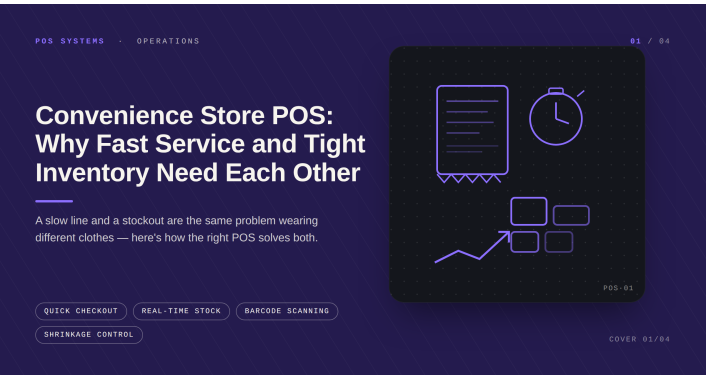
A convenience store's value proposition is simple. The customer is there because they need something quickly and do not want to spend twenty minutes navigating a large supermarket to find it. Speed is the product. The store's entire operational model is built around delivering that speed consistently, across every shift, with whoever is working behind the counter.
That model creates a very specific set of requirements for the point-of-sale system. A slow checkout destroys the core customer promise. An inaccurate inventory count means the item a customer specifically came in for is not on the shelf even though the system says it is. An inability to handle age-restricted products correctly creates a compliance liability. None of these problems have room in a business where the margin for error is already thin.
Why Convenience Store Inventory Is Harder Than It Looks
A convenience store might carry between two thousand and five thousand unique products in a relatively small footprint. The density of SKUs relative to floor space is much higher than a supermarket, and the product mix includes a wide range of categories: snacks, beverages, tobacco, household items, ready-to-eat food, personal care, and in many locations, hot food from a counter or coffee station.
Each category has different movement rates. Beverages turn over daily. Seasonal confectionery moves in bursts around holidays and then stalls. Tobacco products are high-value, theft-prone, and subject to strict compliance requirements in many markets. Ready-to-eat food has a shelf life measured in hours rather than days.
Managing this inventory manually, with periodic count sheets and intuitive reordering, consistently produces two outcomes simultaneously: stockouts on fast-moving essentials and overstock on slower categories that occupies shelf space without generating revenue. The two problems coexist because the information needed to avoid them is not available in real time.
The Compliance Requirement That Cannot Be Ignored
Age-restricted products are a significant revenue category for many convenience stores. Tobacco, alcohol, and in some locations lottery products and energy drinks above certain thresholds all carry legal age verification requirements. A POS system that handles these products correctly prompts the cashier to verify age automatically when the item is scanned, rather than relying on the cashier to remember which products require it on every transaction.
This is not a minor operational detail. In markets where enforcement is active, a single failed compliance check can result in a fine that exceeds a week of margin for that product category. The system needs to make compliance easy enough that it happens correctly on every transaction, including the ones that happen during the lunch rush when the cashier is moving as fast as possible.
Managing a Multi-Shift Operation With Different Cashiers
Convenience stores often run eighteen or twenty-four hours across multiple shifts. A different cashier may be behind the counter for every shift, and staff turnover in convenience retail is typically higher than in most other sectors. This means the POS system needs to be learnable in under an hour and reliable enough that a new staff member does not introduce errors into the inventory on their first night.
Role-based access ensures each staff member can process transactions efficiently without having access to financial reports, pricing controls, or supplier management functions they do not need. Every transaction is logged against the user who processed it, which creates an accountability record that makes end-of-shift reconciliation straightforward and shrinkage traceable.
Shrinkage Is a Bigger Problem Than Most Owners Acknowledge
Shrinkage in convenience retail comes from three sources: shoplifting, employee theft, and administrative error. The first is an operational and security problem. The second is a management and systems problem. The third is a data quality problem, and it is the most addressable one.
When a product is incorrectly logged at receiving, when a return is processed without updating the inventory, or when a damaged item is removed from a shelf without being written off in the system, the recorded count drifts from reality. Over time, those small drifts accumulate into a gap between what the inventory says and what a physical count confirms. The gap is real money, and it shows up in the cost of goods calculation at month-end without a clear explanation.
A convenience store POS system that logs every stock movement, requires confirmation when returns are processed, and generates regular variance reports between recorded and physical counts makes administrative shrinkage visible and therefore addressable. It does not eliminate the problem overnight, but it removes the invisibility that allows it to compound unchallenged.
Loyalty in a Low-Basket, High-Frequency Business
The economics of convenience store loyalty are different from those of a supermarket or a specialty retailer. The basket size is small, but the visit frequency for a regular customer can be daily or multiple times per week. A loyalty program that recognizes this frequency and rewards it appropriately drives a disproportionate share of repeat visits.
Points that accumulate quickly on small purchases, that redeem easily at the counter without requiring a separate app or card swipe, and that occasionally unlock a meaningful reward rather than a tiny discount, create a habit loop that increases both visit frequency and basket size among the customers the business most wants to retain.
Hot Food and Counter Service Integration
Many convenience stores have added a hot food offer, whether a coffee station, a hot food counter, or a self-service heated display. This creates an operational complexity that a standard retail POS does not handle: perishable items that are produced in batches, held at temperature for a defined window, and written off at the end of that window if unsold.
Managing hot food inventory alongside packaged goods requires a system that can handle both product types within the same interface, apply different waste tracking rules to each, and produce a cost report that separates the margin profile of the hot food operation from the retail operation. Without this, the profitability of the hot food counter is essentially unknown, and decisions about which items to offer and at what price are made on instinct.
Multiple Locations and the Visibility Gap
A convenience store operator running more than one location encounters a visibility problem that is difficult to solve without the right technology. Each location has its own cashiers, its own stock levels, its own shrinkage patterns, and its own supplier deliveries. Managing all of this from a central office requires either daily manual reports from each location or a system that provides real-time data from every site in one place.
Centralized reporting that shows live sales, stock levels, and staff activity across all locations gives an operator the ability to identify a performance gap at one store while sitting at another, and to address it with specific data rather than general impressions.
Owners Inventory supports convenience store operations with fast multi-SKU checkout, age-restriction prompts, real-time inventory tracking, shrinkage reporting, role-based staff access, loyalty program management, hot food inventory handling, and multi-location reporting from a single dashboard, starting at $25 per month with a 30-day free trial on every plan.



It's free and takes 2 minutes. There are 1500+ digital agencies in the catalog that are ready to help in the implementation of your tasks. Choose and save up to 30% on time and budget!