
"Everything is gone!", "SEO is coming to the end" and other loud phrases after the Google I/O presentation. Let's figure out what happened
Bard AI responses are displacing organic submissions
During the presentation, we were shown the work of Google's Bard AI. And we saw the following: an artificial intelligence response is generated at the top of the page to the user's request. And the so-called organic matter falls down. That is, to see the same organic results, the user must view the page. Obviously, this will affect your search traffic.
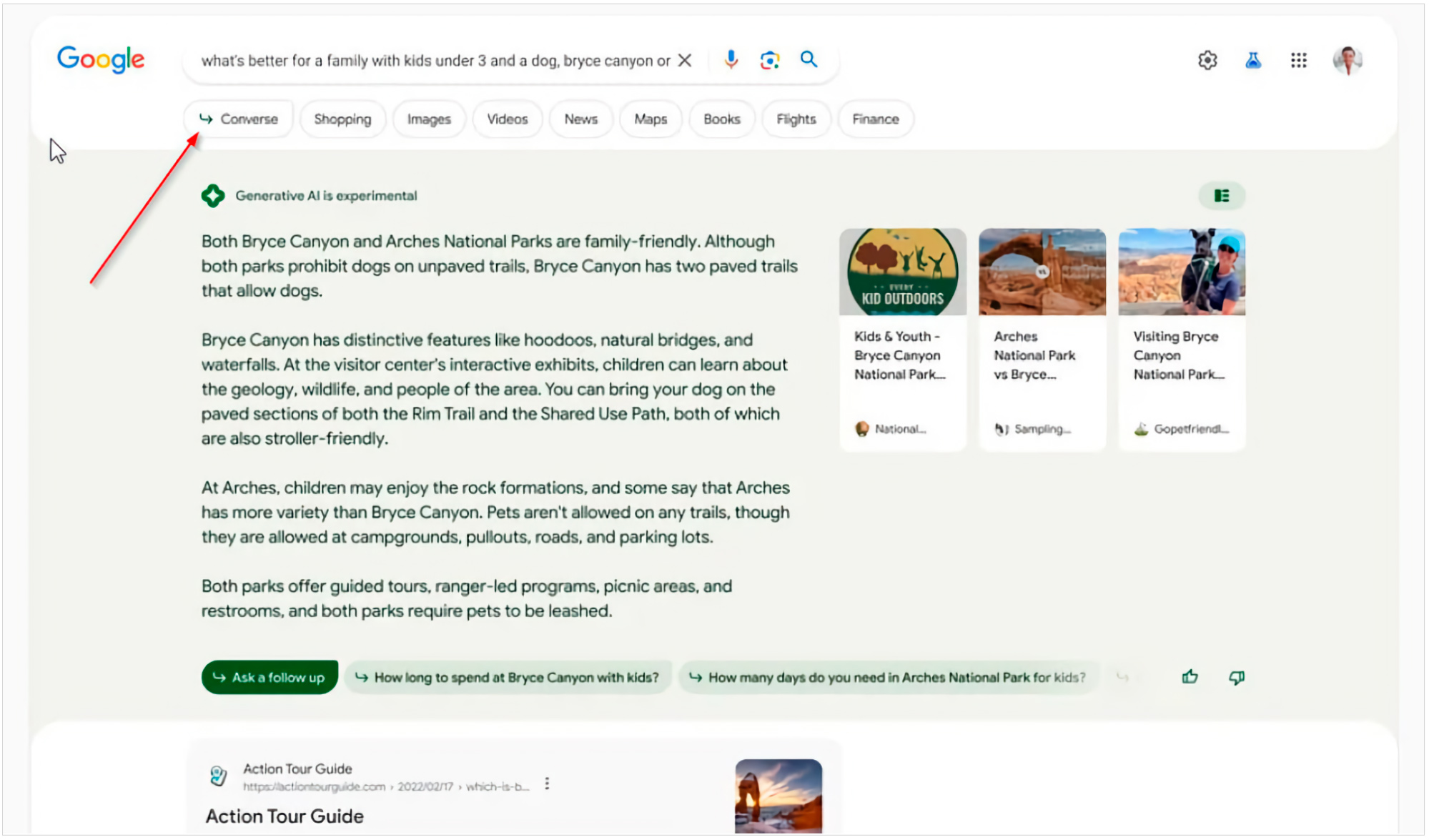
In addition, on the screenshot you can see clickable cards, which AI also selects based on the user's request and recommends to read them. Therefore, there is simply no room left for the same organics on the first screen.
In this regard, the Bing search engine uses space more rationally, where the chat window is displayed on the right, and the organic remains at the top of the page. It is quite possible that Google will also redesign the interface in a similar way in the future, but it is difficult to predict for now.
According to the first impression, the chatbot from Google will repeat the functionality of Bing in many respects. Here you are offered clarifying questions, a button to go to the chat, and links to content sources. At the same time, the company does not forget about its Google Shopping service, integrating product cards into Bard AI responses. Also, Google probably won't apply its AI to YMYL topics, leaving search results and advertising "as is" for such niches.
The integration of artificial intelligence with Mail, Documents and Tables looks interesting. But since this de facto does not apply to SEO, I will not focus on such integrations. We are interested in SEO promotion in new realities.
What will happen to "classic" SEO?
Immediately - honestly, I do not share the decadent mood of many colleagues about the fact that it is time for SEO specialists to find a new job and completely retrain. It does not. SEO is definitely not going anywhere, but it will definitely change, and quite quickly. And you and I will have to adapt to these changes. And it is necessary to start now.
I will tell you what we in the company pay the most attention to in connection with Google updates:
- Google is no longer limited to simple search. Now it is a more functional site, capable of generating answers, tracking user interaction with AI content, optimizing answers to make them more relevant and relevant to a specific person.
- As a result, sites that provide information with evergreen content, such as Wikipedia, may suffer the most, as AI will extract information directly from their pages, without the need for the user to go to those sites. And this is a drop in traffic.
- Resources related to YMYL topics will continue to work and drive traffic as before. Google does not take responsibility for the health and finances of users, so the AI will mostly ignore such topics. Organic search will remain the main source of traffic for such sites.
- "Grey" niches will remain safe. Google is guided by the principle "if it's not added to Google Ads, it's not shown in AI".
- Google will look to trusted sources and share facts instead of providing dynamic information that may change over time.
- Thus, many sites now face a serious competitor in the form of Google. While the AI will link to publishers, as Bing does, it's not yet clear whether they will point to specific pages or just the site. And this is important, because you need to understand where the traffic will go.
As for the aforementioned Google Shopping, it remains relevant, as I said. Take a look at the screenshot:
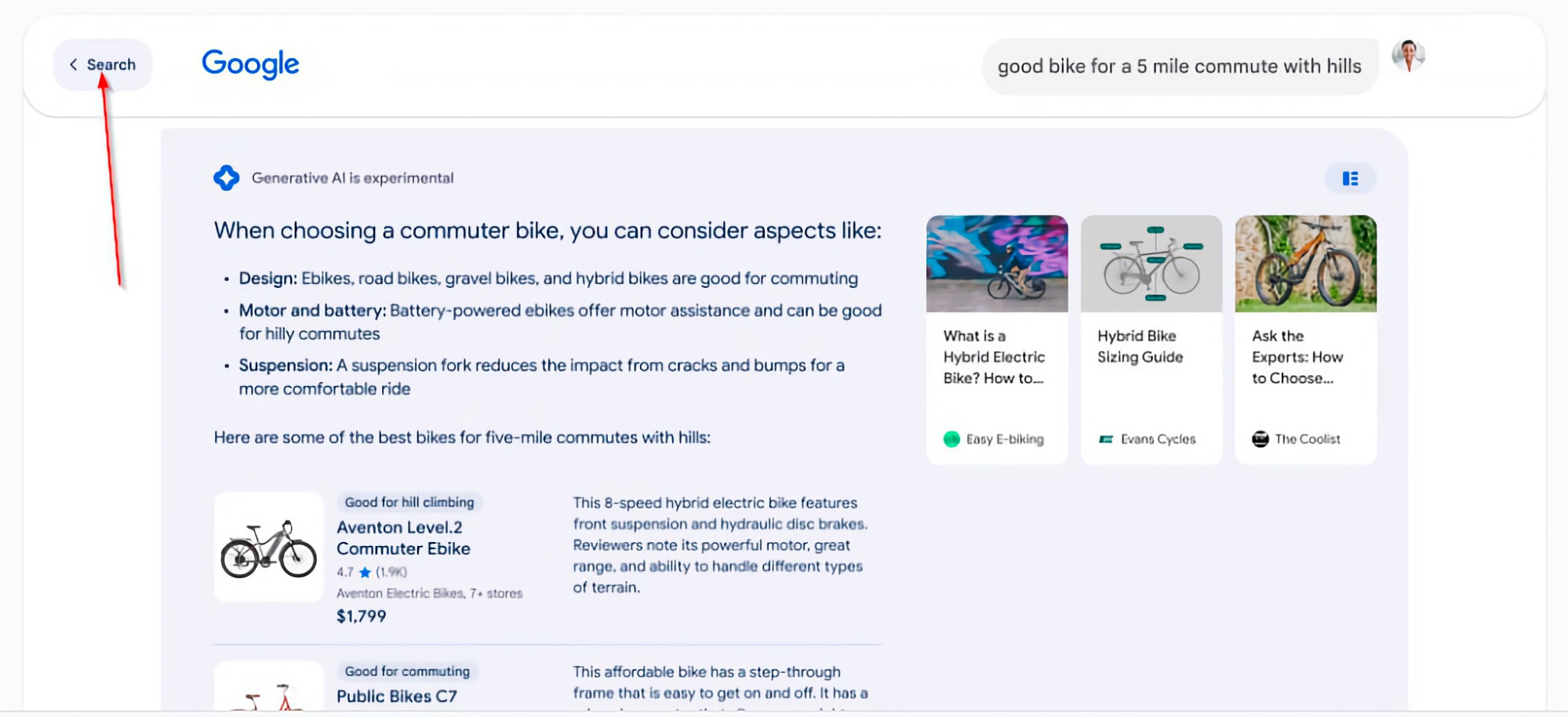
Here we can see that for the query "good bike for a 5 mile hill ride" Google provided product cards with bikes in addition to an AI response with recommendations. And it is quite interesting, because the request is actually informational in nature, predicting, rather, a theoretical answer. However, the AI suggested several suitable bike models for purchase.
It can be assumed that for queries like "best winter tires" or "best sleeping bags for a summer night", Google will not only give theoretical recommendations, but also offer products from Google Shopping. Let's see.
If this happens, pages with content in the style of "Top 5 XXX" and sites with product filters may be "overboard". After all, Google will now create similar selections and filter them according to the user's request. And as a result, such selections can turn out to be much more relevant than those available on the sites.
Who will benefit most from the implementation of AI in Google Search and what should be paid attention to now
In my opinion, the following categories of web resources will win in the long run:
- Sites of monobrands offering original products.
- Pages of goods and services that will be qualitatively optimized under AI.
- Doorway with AI optimization.
I will say more! If the site is really well optimized, quite authoritative and with good expert content, then it will only benefit from the implementation of AI. After all, in addition to organic traffic, traffic from artificial intelligence answers will also be received. I repeat: Google will link to the sources of the content it uses. That's what Bing does right now. More importantly, AI-driven traffic will be “warm”. That is, we are talking about potentially interested customers.
The question is how to get the Bard AI to choose your content and link to you
Here you and I will still have to adapt, analyze the work of artificial intelligence and understand all its subtleties. It will take time and effort. But given that Google's AI is basically in its infancy, we still have some time to study the issue in depth.
Already now I can give several recommendations:
- Use the knowledge graph to link content and pay more attention to its structure. Structuring is very important to AI. The more accurate and logical it is, the easier it is for artificial intelligence to extract information from the site and adapt it to the user's request.
- Adapt the parameters of the product or service to HF requests. It is possible that the era of low-frequency requests is a thing of the past. But, again, we'll see.
- Work on the authority and trust of the site. Otherwise, Google AI will ignore your content.
Many SEO specialists will probably have to change and comprehensively improve their content strategy. Content creation will require more expertise and experience, you will need to think like a marketer, not just a SEO. At the same time, creating text for traffic will not be as effective as before, but will remain relevant.
So how do you get into AI publishing and what do you need to do to do it?
I'm almost 100% sure that Bard AI will have ads. It is already being tested on Bing, and Google is sure to follow suit. Probably, the cost of such advertising will be quite high. But advertising is one thing. And natural hitting in the answer of artificial intelligence is completely different.
My opinion is to keep working hard on SEO and content quality. And I can confirm my words, let's say, in practice.
Let's look at the situation from the example of Bing. I admit, we in the company focus on promotion in Google, because Bing in Ukraine barely gains 0.5% of users, while Google has more than 93%. And even more so, we did not try to adapt the site and content to artificial intelligence algorithms in emergency mode. By and large, my team and I just do classic SEO and pay attention to the quality of the content.
And here are some results!
When asked "Google Discover - what is it and how to get there?" Bing's response links to our site:
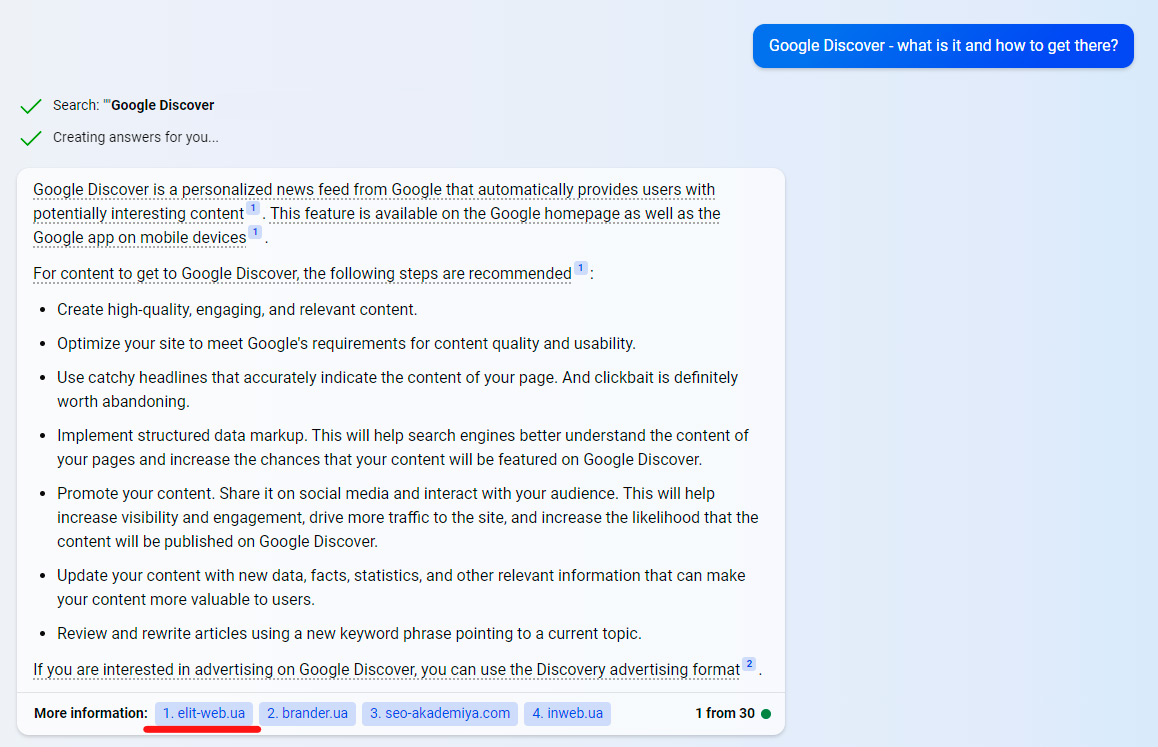
Then it's more interesting. When asked "where to order SEO promotion?" Bing AI also suggests our company as one of the options. At the same time, we are in the TOP-10, not in the TOP-3, in Bing's organic search results. That is, AI algorithms work somewhat differently and take into account different factors than standard ranking algorithms.
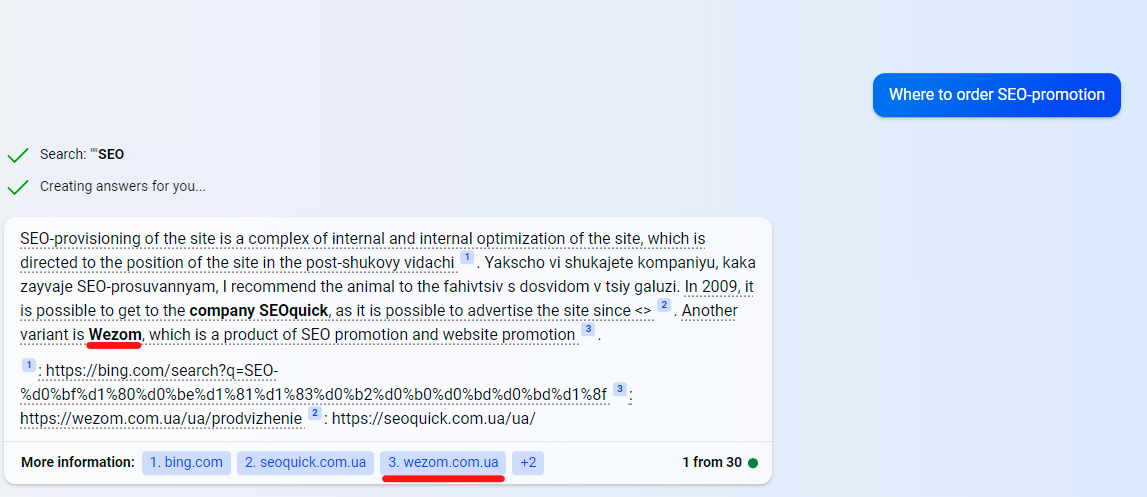
I repeat: we did not optimize the site and content in any special way specifically for AI. And even more so, they didn't buy ads on Bing. As far as I know, it is still being tested and does not work in Ukraine. However, the same SEO that is "everything" works in new realities and can even attract more traffic than before.
What happens next?
And then the tools and methods of promotion will change, as they changed this year, and five, and ten years ago. This is a natural process that should not drive anyone into a stupor for a long time. To say that SEO promotion is no longer relevant and it is time for seoshniks to look for a new job is completely incorrect.
Yes, you and I will still have to adapt to many rather drastic changes. But those who are ready to work and move forward, and not stand still, will definitely win.
Be that as it may, we are following the updates, waiting for the launch of Bard AI in Ukraine and working, working, working!
Thank you for attention. A lot of interesting things are ahead!



It's free and takes 2 minutes. There are 1500+ digital agencies in the catalog that are ready to help in the implementation of your tasks. Choose and save up to 30% on time and budget!