
Offline SEO: How to build authority outside the digital space

Local SEO goes beyond your website. Learn how offline signals—reviews, citations, community presence, and word of mouth—can boost your search visibility.
Before the internet, local businesses promoted themselves offline through traditional channels like print, radio, and television. Then, with the advent of the internet, online promotion opportunities emerged, such as websites and digital assets like Google Business Profiles, which are the foundation of Google Maps and Google Local Search.
Online SEO best practices, such as keyword research, content development, and local business listings, became essential to online marketing and are now well-established.
Many local brands have successfully transitioned from offline marketing to a successful online presence.
Google Maps, launched in 2004, played a key role in enabling local brands to transition from offline marketing to an online presence. Instead of relying on paid advertising in phone directories, any eligible business could be part of Google’s online directory for free.
However, today’s prevalence of spam in local business listings—creating listings for fake business locations and posting fraudulent reviews—has put a new emphasis on offline authenticity. Both consumers and search engines need to be confident that business locations and reputations are being honestly represented online.
With consumer safety and brand trust at stake, if you can prove that your business actually exists and thrives offline, the authenticity you create in the real world can create online rewards and take your marketing strategy to the next level.
In this article, you’ll learn about creating offline signals that will validate your online SEO efforts. (This should not be confused with off-page SEO, a term that refers to digital marketing efforts that take place outside of your website but on the wider internet.)
What is an offline signal?
An offline signal is anything that is not in the digital space but influences consumer behavior or expands Google’s knowledge of your business structure and promotes business authenticity.
Some examples of offline signals include:
- Clear signage in your storefront
- Answering phone calls with a brand name that matches your Google Business Profile
- Credit card transactions in your office
Why offline signals matter now
For over 20 years, local SEO campaigns have emphasized the importance of online digital marketing signals to help your business. However, today there is a shift towards real authenticity through offline signals as local businesses, as well as the search engines and platforms that depend on them, face significant challenges.
Online signals that have been used to guide SEO campaigns in the past include:
- Creating an accurate online presence with essential business information such as name, address, phone number (NAP) on major platforms such as Google Business Profile
- Expanding your brand’s digital footprint with consistent and accurate structured citations—local business listings—in local business indexes such as Bing Places, Yelp, and YP.com
- Growing authority, organic rankings, and local rankings through links from relevant third-party websites
Among the challenges facing local businesses and search engines today are: are:
- Local business listing spam: Environments like Google Business Profile (GBP) are polluted with fake listings and fraudulent reviews, jeopardizing consumer trust in these platforms.
- AI harvests fraudulent local business content: If an attacker has created fake listings or posted fraudulent reviews (which is illegal in the US), AI trained to work with this information will simply recycle the false information, creating a false version of the commercial landscape.
Pound fraud makes headlines, such as Google’s exposure of one organization that created 10,000 fake ads. A recent study estimates that US consumers lose $300 billion annually to review fraud in the healthcare, legal, and consumer services sectors.
A serious problem is that fraudsters can create Google Business Profiles for business locations that do not exist.
For example, a shady garage door repair company may claim to have a showroom at a certain address that, upon verification, turns out to be a blank slate.
Conversely, when a business has clear, physical signage on a real storefront, Google can recognize this, for example, in data collected by Streetview vehicles and other methods. Google may also collect information such as foot traffic, location, Wi-Fi, and point-of-sale data to verify the legitimacy of a business location.
What is considered an offline-to-online signal?
Developing authenticity is critical for local businesses because it serves as digital proof that a business is real.
Here are a number of signals that can help distinguish a legitimate business from a scammer, reducing the chances of it being flagged as a fraud by Google and removed from its local business index.
Foot traffic and location data
A combination of technologies allows Google to accurately or roughly determine a user’s location and movement. In the Local Search settings, Google can track consumer behavior using:
- GPS signals
- position and velocity sensors, such as accelerometers and gyroscopes
- mobile network signals
- Wi-Fi signals
When device users allow Google to collect their location, Google uses this information to populate GBP features such as Popular Times, Visit Duration, and Wait Score.

Thinking back to our hypothetical showroom of fake garage doors in an empty field, it's easy to see how the presence of these basic signals of real-world consumer behavior can confirm Legitimacy in Google's eyes - it's unlikely that an unknown location will have hours of popularity.
Wi-Fi and network presence
The data Google collects through cellular and Wi-Fi technologies can help distinguish real businesses from fake ones. Google notes:
"Cellular and Wi-Fi signals can help Android estimate the location of a device, especially in environments where GPS signals are unavailable or inaccurate, such as in densely populated urban areas or indoors."
Point of sale and transactions (indirect signals)
Google tracks consumer credit card transactions, providing it with proof that sales are actually taking place at a specific location. Additionally, when store apps integrate with services like Google Analytics, Google also has access to this data.
There is a clear correlation between transaction volume, consumer activity, and business existence, although these signals don’t necessarily guarantee a brand’s credibility. Fraudsters can also have a large volume of these metrics.
Local press, sponsorships, and offline mentions
Any online mention of a local business that Google indexes adds to its understanding of that entity—these are known as structured citations. They are becoming increasingly important because they ensure the credibility of real companies.
For example, when a local news story mentions that a siding company donated materials and labor to renovate City Hall, Google may index structured citations like these:

Sources of structured citations may include:
- Sponsoring local events, teams, and organizations
- Hosting and participating in community events
- Cross-promotion of B2B on local business websites
- Citation or contribution to hyperlocal blogs, podcasts, and video channels
- Creating scholarships
- Advertising in or being cited by local newspapers, radio, or television
- Mentions on social media and discussions on forums
Any online record of offline business activity builds trust in an organization. Google instructs its quality reviewers, who evaluate whether users are returning relevant results, to look at a variety of sources to understand a business’s reputation. Consumers are also exposed to these structured quotes.
It’s understandable that a non-existent business would be unlikely to participate in a promotion like an offer to paint the local city hall.
User-generated proof
While reviews have become a prime target for scammers in the local business sector, there are several elements that can increase the legitimacy of this content, including:
- Photos included in reviews prove that the customer was actually in the store or hired the company to provide the service.
- Videos included in reviews that show customers visiting stores, storefronts, products, staff at work, or completed projects.
- Handwritten reviews collected directly from customers by the company create an authentic, human touch.
- Location tags on social networks on platforms like Instagram, TikTok, and Facebook that associate social media posts about local businesses with specific geographic locations, such as visiting #cupcakebakery in #sanfrancisco.
Such signals not only instill consumer trust in the credibility of brands, but also contribute to Google’s understanding of the authenticity of local organizations.
How search engines collect and interpret offline data
Search engines like Google have extensive data processing channels to capture consumer movements, behaviors, and transactions. This is done through a combination of:
- Mobile carriers
- Android/iOS signals
- Location tracking
- Partnerships with aggregators
- Product usage, such as using Google Analytics
Google claims to use the following collected data behind the scenes to:
- Make the online experience more useful
- Help users remember places they've already visited
- Reflect anonymous community trends, such as hours of popularity in a business environment
While the very nature of Google's algorithm makes it difficult to claim that user or business data directly influences local rankings, such data can certainly indicate that location business is real and people visit it.
Google's focus on factual local data
Several patents and patent applications by Google are aimed at linking search queries to specific results based on human activity. All of this is part of Google's efforts to create an online mirror of the offline world.
For example, one patent focuses on "determining the geographic location of objects that appear in search queries." In this dynamic, Google refers to the use of geospatial signals to associate website content with real-world objects, such as buildings and landmarks.
Mapping offline behavior to digital signals
Google can cross-reference multiple data points.
For example, imagine a company creating a Google Business Profile for a business called “Vegan Pizza Pan” at 600 Market Street in downtown San Francisco. Then, a Google Streetview car drives through the area and takes pictures of the business at that location with a sign reading “Mike’s Pizza.”
This creates a dilemma for Google (and customers): Is “Vegan Pizza Pan” the same business as “Mike’s Pizza”?
Imagine Google then calling the business and the employee simply answers, “Mike’s.” A Google representative will need to ask additional questions to verify the real name of the place.
If an ad is suspended because Google is unsure of its name, the owner will need to provide documentation (such as business licenses and tax certificates) that proves the full legal name of the business is “Mike’s Vegan Pizza Pan.”
All of these issues could have been avoided if you had been consistent with your offline branding.
Tactics to Strengthen Your Offline Authority Online
Use these tips to create a strong digital record of your offline presence so that both consumers and search engines like Google have ample evidence of your business’s legitimacy.
Encourage reviews with context and authenticity
Google has become so adept at analyzing image content that it can now group photos together.
Take a look at this example of a GBP photo set divided into over a dozen image categories:

Imagine a user trying to find a local place to order a Cuban sandwich. Customer-taken photos of this menu item will definitely boost a user’s confidence that this restaurant can meet their needs, as the photos serve as proof:

The images section isn’t the only area of a company’s Google profile where the public can upload photos. Reviews with photos say “I’ve been here” to both other customers and Google, like this review showing off a Cuban sandwich:

Encourage reviewers to include images in their reviews with these tactics:
- Create a photo-worthy physical location. Consider the inviting restaurant mentioned in the above review: it’s a place that customers love to take photos of because of its aesthetics.
- Create in-store signage that lets customers know you’d like them to take photos of your establishment and leave a review.
- Designate selfie spots that will inspire customers to take photos of themselves in your establishment.
- Update your review request templates to specifically ask customers to upload photos when writing reviews.
- Send photos to clients of service-based businesses (SABs) such as contractors, landscapers, and interior designers, showing “before” and “after” shots or completed projects. Ask customers to use these images in their reviews.
- Experiment with sending photos of products and services as part of your review requests, but make sure the images are unique and not from the manufacturers, otherwise your reviews will look suspicious rather than authentic.
- Share customer-uploaded photos on your social media profiles, giving socially active customers an extra reason to want to take a picture of your business.
- Diversify your evidence by asking some customers to provide handwritten reviews during service delivery. Publish this content on your website as GBP update posts, GBP images uploaded by the owner, and on your social media profiles.
Leverage local PR and community relations
Community service can create strong signals of authenticity.
We previously looked at the example of a siding company renovating a local city hall. Almost any local business can get similar PR by taking these steps:
- Plan to contribute to the community by hosting/participating in events, donating to worthy institutions or local causes, sponsoring projects or sports teams, or developing other forms of philanthropy.
- Reach out to relevant parties: For example, reach out to a local no-kill animal shelter and ask if they would be willing to donate 5% of your sales during the holiday shopping season. They will likely be receptive to the offer.
- Reach out to local media outlets with your story. These could be local journalists, bloggers, podcasters, video channel hosts, etc. Give them something to talk about in their never-ending search for fresh and interesting local content.
- Once your community outreach stories are published, be sure to share them on your website and social media, which will increase the chances that they will be seen by the community and indexed by Google.
- If the project has an end date, set a time for the next community engagement initiative to begin and repeat the process.
- A single program can earn your business several structured links that will prove your community’s authenticity and set you apart from questionable brands.
Optimize your physical location for digital feedback loops
Not only does legible signage in your storefront help pedestrians and drivers find your space on the street, but Google can also read this content in photos. This is an important part of proving that you are a real business.
Invest in eye-catching signage that customers want to take pictures of, like the one in the following example, which consistently signals that real people have visited this dairy bar:

Integrate offline data with your own developer systems
Experiment with loyalty app check-ins and QR codes to bridge the offline and online customer experience.
Loyalty Apps
Loyalty apps are designed to improve customer retention, reduce the cost of acquiring new customers, and increase sales by offering existing customers consumers with points or other rewards for signing up.
Local retail brands registered with Google Merchant Center (GMC) can also use its loyalty program where available.
This GMC add-on allows you to run offers such as customer points, free shipping offers for repeat customers, and discounts for repeat customers. Activity can be tracked with the Loyalty Program Performance Report, and of course, any Google product you use provides the search engine with additional information about the validity of your business.
QR Codes
QR codes aren’t right for every business, and the most data on their success in the world of small, local businesses tends to come from the restaurant industry. Consumer reactions to them have also varied.
A Toast survey found that:
- 81% of restaurant diners still prefer printed traditional menus over QR codes
- 26% say the small font of QR codes is their least favorite
Uniqode has an interesting overview of QR code experiments for your inspiration, but it’s mostly geared towards larger businesses.
What might be more applicable to local brands of all sizes is Google’s QR code generator for Google Business Profile reviews.
Find your business on Google and click the “ask for reviews” button on the New Merchant Experience screen, which will open this screen:

This will generate a QR code that takes customers directly to the action of leaving a review for your GBP.
Another very simple way that local businesses can improve their authenticity signals from offline to online is by posting about selected events on Google Updates. Here’s an example from a hot dog restaurant that offers a recurring special event:
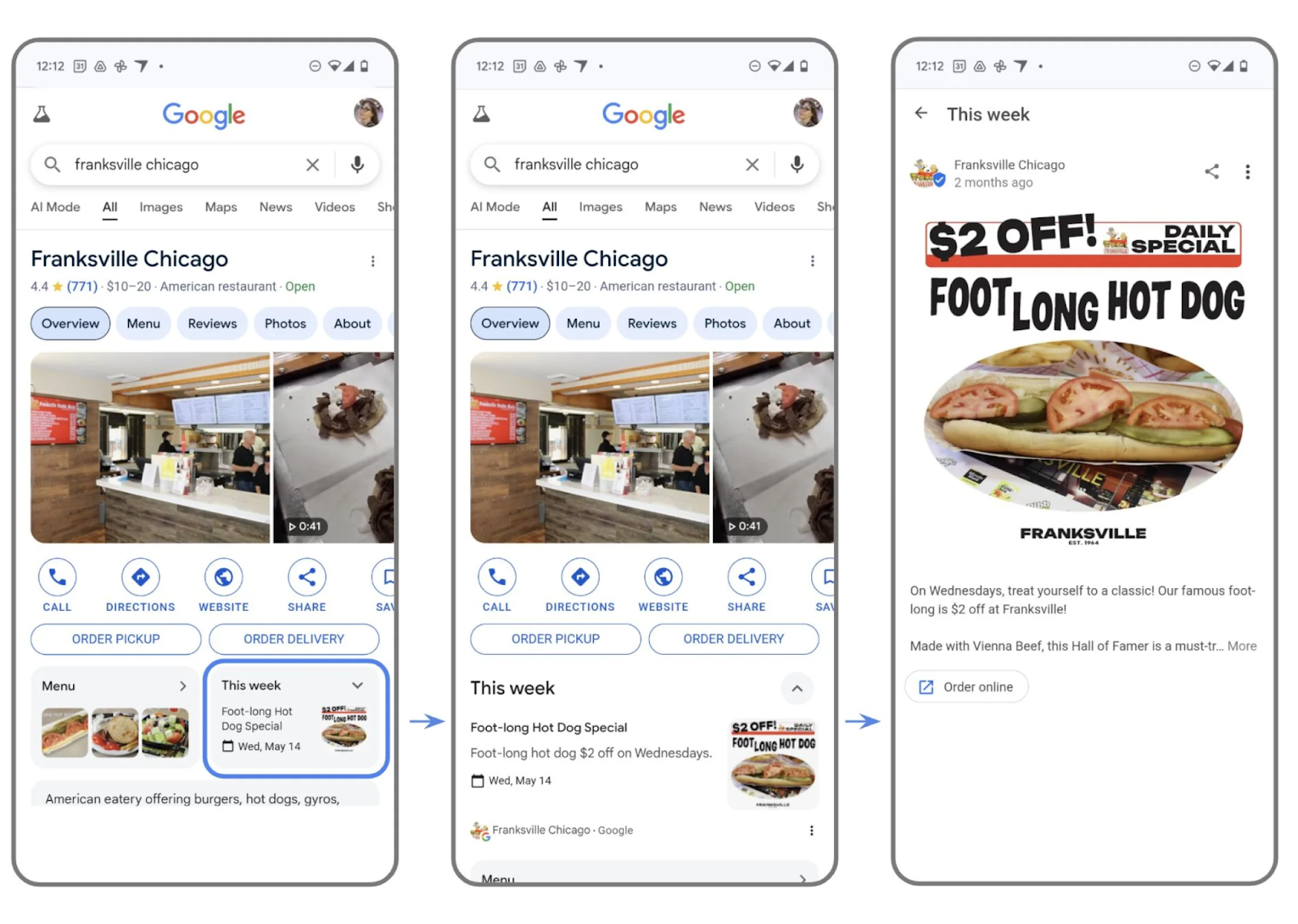
However, as Claudia Tomina points out in her recent post on why some GBP event posts aren’t showing in your ads:
- This type of post is only available for certain business categories.
- It’s only available on mobile devices.
- Posts should include both day of the week and time information so that Google has enough context to show these posts on the right day: For example, Google might reject a post with the text “Happy Hour 4:00 PM to 6:00 PM,” but will accept “Happy Hour every Monday – Thursday from 4:00 PM to 6:00 PM.
Schema
While posts about featured events are limited to the GBP category, there are no restrictions on which businesses can use Schema to mark up events published on your website and third-party sites.
Google offers this comprehensive guide, including code examples, for creating structured data around events. By following Google’s guidelines closely for directly providing them with event content, your major events can appear in the Events feature of the SERP, increasing engagement and signaling to Google that your business is real and hosts real events:

Measuring the impact of offline signals
How do you know if your authentication efforts are working? Track these four patterns to measure how real-world activity drives online business growth.
Improve your Google Business Profile Performance by Improving Customer Service
The most direct KPI for the offline-to-online business transition that any local business can measure is the impact of customer service on customer ratings and review sentiment.
A large review survey by GatherUp shows that 60% of consumers feel motivated to write negative reviews to alert their communities to a bad experience.
Only 24% would choose to do business with a business with an average rating of 3 stars.
If your business is in the 3-star danger zone, you can track the results of your customer service initiatives by:
- Increasing the number of reviews. The same survey shows that the main motivation for reviewers is to be rewarded for a great customer experience.
- Increase in positive sentiment in reviews related to your new initiative. Sort your reviews in GBP using the “most recent” tab to analyze sentiment over a period of time.
- Gradual positive impact on your average rating in GBP.
- Increase in conversions as your average rating improves and your recent reviews speak to a positive customer experience. This can include more requests for directions, more clicks to call, and more website clicks from your GBP, as shown in the Performance tab of the new merchant experience dashboard.
- Increased sales as a result of increased GBP conversions.
- Increased Local Pack and Maps rankings due to increased star rating, review age, and number of reviews, which are hypothetical ranking signals.
Increased review age through active review acquisition
Research and surveys show that review age impacts both local rankings and consumer behavior. Most consumers say they look to the most recent reviews first when trying to figure out whether to trust a local business with a transaction.
Given the impact of this one metric, a proactive review campaign is essential to prove that real people are visiting a real business and that the local community can trust that business.
Before you start a new review campaign, measure the rate at which your business typically receives reviews.
For example, a small business might receive 10 new reviews per month without prompting. Once your campaign is up and running, track your inbound response rate to see how proactive email, text, signage, print, and in-person inquiries are driving this important metric.
Increase your digital footprint with the power of unstructured quotes
We’ve looked at numerous examples of brands successfully working in communities and how it can lead to great online PR. When you launch a new community outreach campaign, track its results in terms of:
- The number of new mentions of local publishers in online news, hyperlocal blogs, local podcasts, video channels, etc.
- The authority of new unstructured citations — online mentions of your business in anything other than an official local business directory. Document the types of posts that mention your brand and measure their authority using a free tool like Semrush’s Website Authority Checker to assess the SEO benefits each mention provides, as well as validate the underlying authenticity of your local business.
- Include top structured citation sources in your “How did you hear about us?” consumer surveys to track whether specific mentions drive consumer discovery.
Correlating Online Performance with Offline Results
Gain insight into whether the above improvements in online visibility and reputation are linked to increased offline activity by using mobility data tools like Placer.ai and SafeGraph. These products track:
- Foot traffic
- Demographic information
- Visitor behavioral signals, such as visit frequency and length of stay
In theory, improving the customer experience should improve reputation metrics, such as average star ratings and positive recent customer sentiment in reviews. This, in turn, should increase offline activity, such as visits and transactions.
The Future of Offline-to-Online Local SEO Strategy
It’s too early to predict the extent to which local consumers will adopt options like artificial intelligence into their local business processes. If these products provide accurate information that is more useful than existing formats like Google Local Packs and Maps, then there is a good use case for this technology.
However, if they collect and promote local business listings and review fraud that misleads and harms consumers, they are unlikely to gain public trust.
Here are some developments to watch for.
Google’s Removal of Review Fraud
Google regularly publicly announces its efforts to combat review fraud, such as in this blog post, which states that they removed 45% more suspicious reviews in 2023 compared to 2022.
Google has said that the advancement of its machine learning algorithms is helping these efforts, but local businesses have a better idea of how It’s the listing and review fraud that’s impacting their communities, despite these removals.
With AI enabling review fraud to scale, local brands should pay close attention to whether consumers’ trust in third-party reviews is rising or falling over time.
New Google Lens Features Roll Out
The AI-powered image recognition technology is being touted as revolutionary.
Google says that 72% of shoppers use their phones while shopping in-store, and that more than half of consumers leave stores without making a purchase due to a lack of trust in a particular product.
All retail models should check out Google’s ever-evolving suite of in-store and local shopping features powered by Google Lens.
While you can’t send images directly to Google Lens, you can run product images from your Google Business Profile via the Cloud Vision API to see if Google can recognize them.
Do augmented and virtual reality (AR/VR) have a real use case for local brands?
AR and VR are classic examples of well-funded technological experiments that attempt to achieve their goals of changing people’s behavior.
Despite statements like those from Meta CEO Mark Zuckerberg that people without augmented reality glasses will be at a disadvantage in the future, Meta’s Reality Labs is reporting quarterly losses in the billions of dollars.
Practically speaking, AR/VR technology is not currently needed by most small and medium-sized local businesses.
However, corporate brands may want to experiment with “try before you buy” features. For example, Macy’s Room Planner helps customers preview how furniture will look in their homes.
The right mix of new technologies will be unique to each business. Experimentation is key, but so is thoughtful observation, which will allow you to distinguish between practical use and mere marketing hype.
Every legitimate local business has several options for proving its authenticity to both search engines and consumers. The best results are achieved when you combine credibility with a strong reputation for delivering an excellent customer experience.
Learn more about consumer behavior
Online experiences drive offline wins, and your brand can’t maximize potential customers without creating a solid digital experience for them.




It's free and takes 2 minutes. There are 1500+ digital agencies in the catalog that are ready to help in the implementation of your tasks. Choose and save up to 30% on time and budget!