
Popunder vs Pop-Up: What's the Difference and Which One Converts Better
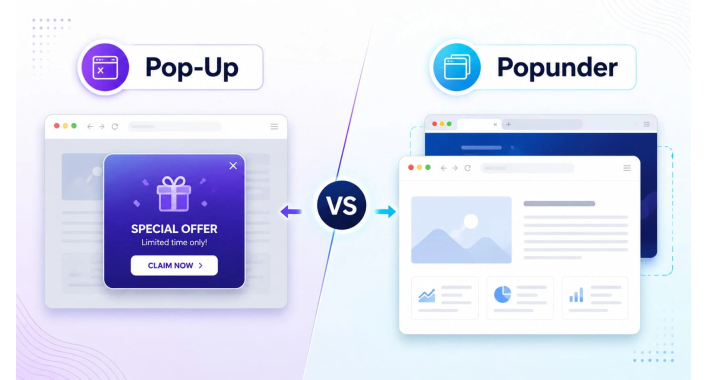
Ask most people outside of performance marketing what a popunder is, and they'll describe a pop-up. The two formats are routinely conflated — by users, by marketers who haven't run both, and even by platforms that list them interchangeably. They are not the same format, they don't reach users in the same way, and they don't produce the same results.
Understanding the actual difference between popunder and pop-up advertising matters because the choice between them affects campaign performance, user experience on publisher sites, and the long-term viability of your traffic source. This article breaks down how each format works, where they diverge in practice, and which one the data consistently favors for performance campaigns.
How Pop-Up Ads Work
A pop-up ad opens a new browser window or overlay directly in front of whatever the user is currently doing. It appears immediately and without invitation — covering the active content, demanding attention before the user has completed the action that brought them to the page in the first place.
The defining characteristic of a pop-up is interruption. The user is reading an article, watching a video, or filling out a form, and the ad appears over it. To continue what they were doing, they have to deal with the pop-up first — either by engaging with it or closing it.
Pop-ups were ubiquitous in the early internet era and generated high visibility precisely because they forced themselves into the user's field of view. That forced visibility came with a cost that became apparent quickly: users hated them. Browser vendors responded by building pop-up blockers into their products starting in the early 2000s, and by the mid-2000s native pop-up blocking was standard across every major browser.
Today, pop-ups that open new windows are blocked by default in Chrome, Firefox, Safari, and Edge. The format has largely survived in a modified form — as on-page overlays and modal windows that are technically part of the page rather than separate browser windows, and therefore not caught by standard pop-up blockers. These overlay pop-ups are common in e-commerce for email capture, exit-intent offers, and cookie consent, but they operate differently from the original pop-up format and aren't what most ad networks mean when they list pop-up as an ad format.
How Popunder Ads Work
A popunder ad also opens a new browser window — but behind the active tab rather than in front of it. The user doesn't see it while they're engaged with the publisher's page. It loads silently in the background and surfaces only when the user closes or minimizes their current window, at a natural moment of transition between tasks.
This single mechanical difference — behind versus in front — produces a fundamentally different user experience. The popunder doesn't interrupt anything. The user completes whatever brought them to the page, and only then encounters the ad. By that point they're in a different attentional state: task complete, ready for the next thing. The ad appears on its own terms rather than forcing itself into an existing context.
Popunders are also significantly harder for browsers to block than traditional pop-ups. Because the trigger mechanism and timing differ from the patterns browser pop-up blockers are designed to intercept, popunder delivery rates are substantially higher than pop-up delivery rates in the current browser environment. For advertisers buying popunder traffic, this means impressions that were paid for are actually delivered — not silently blocked before the user ever sees them.
The User Experience Gap
The user experience difference between the two formats is not subtle, and it has direct consequences for conversion performance.
A pop-up that interrupts a user mid-task generates an immediate negative response. The user's primary objective — reading, watching, purchasing — has been blocked. The emotional response is frustration, and that frustration transfers to whatever is in the pop-up. Even if the offer is genuinely relevant, the user's first instinct is to close the interruption and return to what they were doing. Studies on user behavior consistently show that pop-ups are closed within one to two seconds of appearing in the majority of cases, with little to no engagement with the content.
A popunder that surfaces after the user has finished their session arrives without that accumulated frustration. The user has completed their task. There's no competing priority. The ad gets a clean look rather than a reflexive close. Time-on-page metrics for popunder landing pages consistently outperform those for pop-up landing pages, which is a direct indicator of the attentional quality difference between the two formats.
For publishers, the experience gap is equally significant. A pop-up that covers editorial content damages the reading experience in a measurable way — bounce rates increase, session duration drops, and repeat visit rates decline. Publishers who rely heavily on pop-up formats pay for that short-term revenue with long-term audience erosion. Popunders, by contrast, generate revenue from every visitor without touching the content experience at all. The page the user came for remains intact; the monetization happens in the background.
Conversion Performance: What the Data Shows
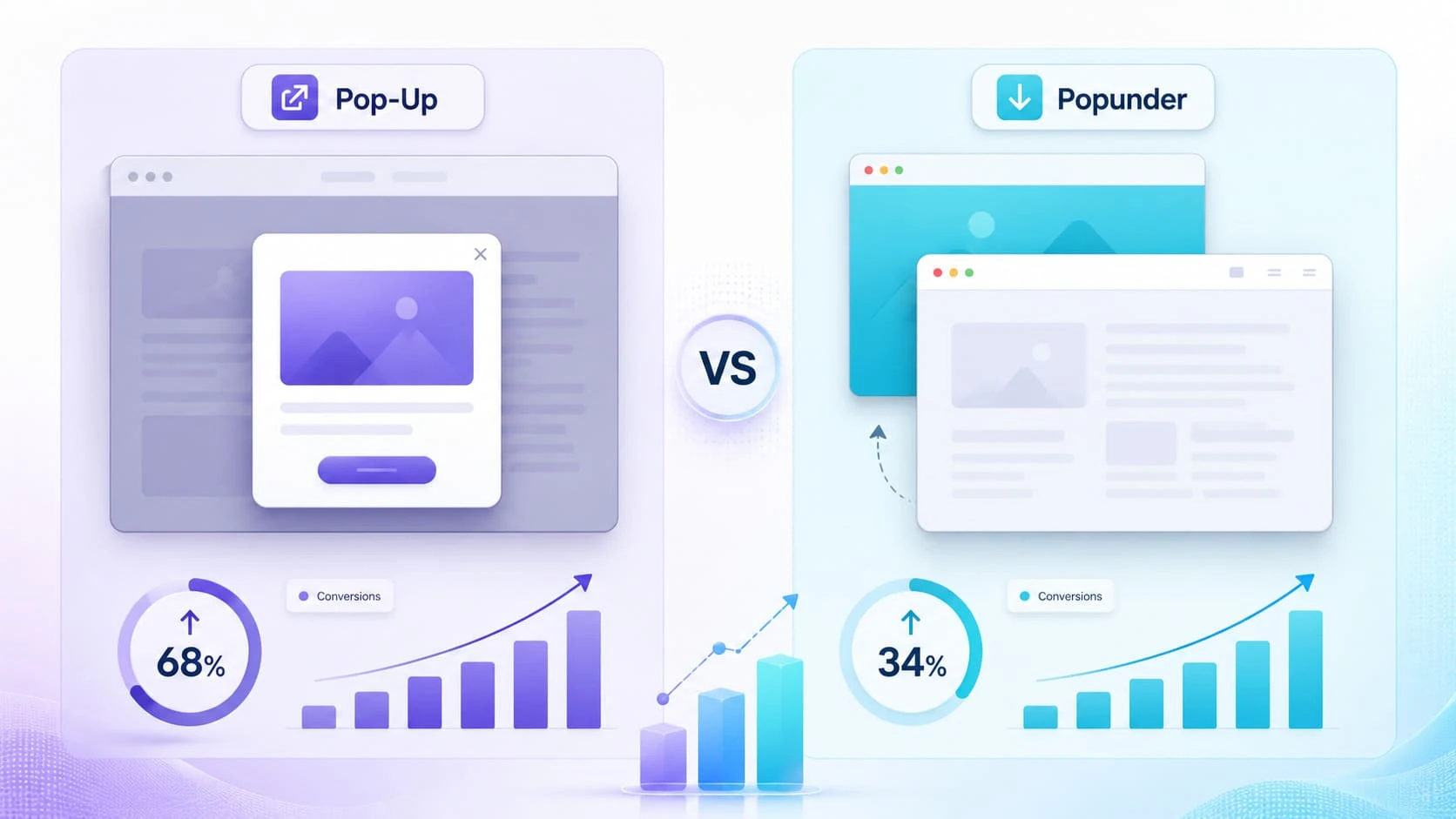
The conversion comparison between popunder and pop-up advertising consistently favors popunder across the performance verticals where both formats compete.
The reasons connect directly to the user experience factors described above. Conversion requires a user who is receptive to an offer. A user who is frustrated by an interruption is not receptive — they are in a problem-solving state focused on removing the obstacle, not evaluating whether the offer is relevant to them. A user who encounters an ad at a moment of natural transition has no obstacle to remove. The offer gets evaluated on its own merits.
Popunder campaigns in verticals like app installs, gaming, sweepstakes, VOD subscriptions, and lead generation regularly outperform equivalent pop-up campaigns on cost-per-acquisition metrics, particularly in Tier 1 GEOs where users are most sensitized to interruptive advertising and most likely to close a pop-up reflexively.
There is one context where pop-up formats — specifically on-page overlay pop-ups, not new window pop-ups — retain a conversion advantage: exit-intent capture on e-commerce sites. A modal that appears when a user moves their cursor toward the browser close button, offering a discount on the items in their cart, is interrupting an action the user was already about to take anyway. In that narrow context, the interruption is less disruptive because the user's session on the page was ending regardless. But this is a specialized use case for first-party site optimization, not a format available through ad networks in the same way popunder is.
Advertiser Considerations: Which Format to Run
For advertisers buying traffic through ad networks, the practical choice in 2026 is almost always popunder over pop-up, for three reasons.
Delivery rate. Pop-up blockers catch new-window pop-ups at high rates. Popunders are delivered more reliably across the browser landscape. When you buy impressions, you want those impressions to actually reach users — popunder has a structural delivery advantage that affects the real cost of every conversion.
Traffic quality. The attentional state a user is in when they encounter your landing page affects how they behave on it. Popunder traffic arrives in a lower-friction state, which produces better engagement metrics and more accurate conversion data for optimization.
Publisher relationships. Networks that rely heavily on pop-up inventory tend to work with lower-quality publisher sources, because the format's impact on user experience limits the publishers willing to use it. Popunder networks have access to a broader and generally higher-quality publisher base, which benefits the traffic quality of every campaign running through the network.
Publisher Considerations: Which Format to Implement
For publishers, the calculus is straightforward. Popunder monetizes every visit without touching the content experience. Pop-up formats generate higher immediate visibility but at the cost of user experience metrics that compound negatively over time.
Publishers who have tested both formats consistently report that popunder maintains audience quality — measured by return visit rate, session duration, and pages per visit — at levels that pop-up formats don't. The revenue per session difference between the formats is real but narrower than the long-term audience value difference. A publisher who monetizes with popunder and retains their audience earns more over twelve months than one who monetizes with pop-up and watches their audience erode.
The Bottom Line
Pop-up and popunder ads share a mechanical origin but diverge completely in execution, user experience, and conversion performance. Pop-ups interrupt; popunders surface at transition. Pop-ups generate reflexive closes; popunders get evaluated on the merits of the offer. Pop-ups are blocked by default in every major browser; popunders are delivered at high rates across the same environments.
For advertisers running performance campaigns and publishers monetizing traffic, popunder is the format that makes sense in 2026 — not because pop-ups don't work at all, but because popunder works better across the metrics that actually determine whether a campaign is profitable and whether a publisher's audience stays healthy over time.
GTaro is a global ad network specializing in popunder and other high-performance formats, with traffic across 230+ GEOs, three-layer anti-fraud filtering, and real-time campaign reporting.


It's free and takes 2 minutes. There are 1500+ digital agencies in the catalog that are ready to help in the implementation of your tasks. Choose and save up to 30% on time and budget!