
Professional Web Design in the Age of AI Search and Personalization
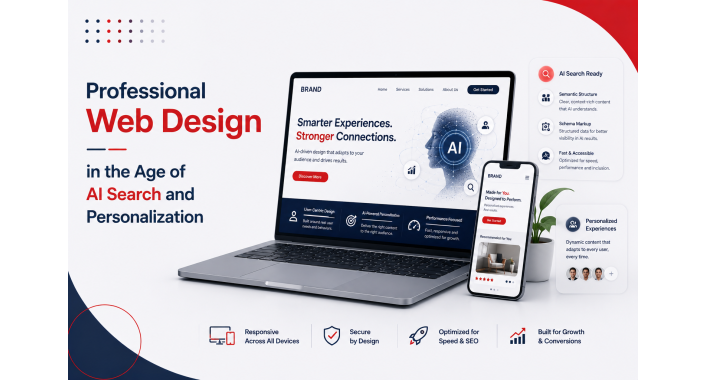
For a long time, building a company website was a linear project. Designers drew static wireframes, developers wrote code, and marketers spent months tweaking layout elements to capture traditional search traffic. Once a site went live, it sat largely unchanged for years.
That static approach no longer holds up in today's digital ecosystem. AI has made digital design more than a layout-creation platform - it is now a powerful tool for real-time customization and search optimization. With professional web design, digital platforms are now live systems that can modify their layouts on their own, deliver personalized content streams, and structure their code for AI search.
Designing for Answer Engines and Generative Search
Search engines no longer rely strictly on displaying a list of blue links. Generative answer platforms now synthesize information directly on the results page. If your site layout hides core business facts behind vague marketing claims or messy code, these engines simply pass over your content.
Executing modern professional web design requires building for machine readability alongside human visual standards-
- Rigid Semantic Hierarchy- Generative models extract data best when content follows a clean structural blueprint. Using a strict HTML heading structure (H1, H2, H3) alongside explicit schema markup gives automated crawlers direct access to your core business data.
- Machine-Verifiable Entity Signals- Answer engines actively favor sources with explicit proof of domain authority. Incorporating transparent credentials, structured service specifications, and verifiable author details turns your platform into a trusted reference point.
- Speed as a Strict Requirement- Generative engines evaluate technical site performance aggressively. Pages bogged down by slow Core Web Vitals metrics or unoptimized script libraries lose search visibility because automated crawlers reject slow response times.
Hyper-Personalization and Adaptive UI Layouts
Static landing pages treat every visitor identically. An executive seeking enterprise software sees the exact same page layout, copy, and call-to-action buttons as an entry-level researcher looking for a basic PDF guide.
|
Dimensional Attribute |
Static Website Model |
Adaptive Machine-Learning Model |
|
Hero Section |
Identical message for all users |
Dynamic headlines based on search intent |
|
User Pathways |
Rigid, fixed navigation menus |
Contextual navigation paths based on past visits |
|
Conversion Touchpoints |
Generic contact forms |
Predictive call-to-action placement |
|
Content Delivery |
Uniform product displays |
Real-time recommended service modules |
Modern user interface design uses machine learning models to adapt web layouts based on real-time visitor signals, creating a far more relevant user journey.
Behavioral Layout Adjustments
By evaluating real-time visitor context - such as referral channels, geographic locations, device types, and past browsing paths - adaptive layouts shift instantly. A returning customer might immediately see an account management portal or relevant upgrades, while a first-time prospect gets an educational explainer video.
Contextual Call-to-Action Placement
Predictive analysis identifies where users stop or leave the web page. Instead of flooding every screen with pop-ups, smart systems trigger relevant calls to action when the visitor shows signs of purchase intent.
Subtle Micro-Interactions
In contemporary web design, feedback loops in interfaces keep users engaged. Responsiveness, smooth transitions, and clear navigation make these platforms feel lightweight, easy to use, and intuitive.
How AI Tools Elevate Human Creative Workflows
A common misconception is that ai replaces human creativity in modern web design. In practice, it frees designers from tedious, repetitive labor.
By using automated tools for wireframing, asset scaling, and code checks, designers can focus on higher-level concepts such as brand story and complex user psychology.
In collaboration with the UI UX Design Services, the developing business can create its own unique, high-quality visual system that looks great and works well on any screen.
Balancing Technical Innovation with System Agility
Adopting dynamic personalization and generative search optimization does not require building fragile, custom-coded web architectures from scratch.
Many growing brands rely on open ecosystems to run their online operations. Partnering with a skilled custom website design and custom WordPress development team allows companies to combine lean theme code with modern API integrations. This keeps backend content management simple while giving your marketing team full control over dynamic content, schema management, and page performance.
Operational Steps for Modernizing Your Digital Footprint
Upgrading your online presence to meet modern machine search standards requires a structured execution plan-
- Eliminate Code Bloat- Remove unnecessary tracking scripts, outdated plugins, and unused CSS libraries to ensure instant page render speeds across mobile networks.
- Implement Structured Schema Markup- Add detailed JSON-LD schema for your physical locations, service lines, author profiles, and core services offered.
- Format Content for Quick Extraction- Break up long blocks of text into clear subheadings, short definitions and scannable bullet points.
- Deploy Privacy-First Personalization- Personalize user journeys using first-party behavioral signals while maintaining visitor data privacy standards.
- Monitor Search Summaries- Regularly query generative answer tools to evaluate how your brand is cited, framed and represented in direct search responses.
Strategic Guidance for Enterprise Teams
To optimize ROI from a digital rebranding effort, view the website as a constantly evolving product rather than a project.
User Experience First- Machine readability gets you cited in answer engines, but intuitive user experience services are what convert those visitors into paying clients once they land on your site.
Invest in Scalable Design Systems- Create clear visual guidelines, component libraries and typography scales so that new landing pages can be deployed quickly without compromising brand consistency.
Mobile Performance Matters- Ensure that all interactive elements, dynamic layout changes and personalized modules load smoothly on smaller mobile screens.
Closing Thoughts
The way we discover digitally has changed forever. Static brochure sites are rapidly losing search traffic to intelligent, highly flexible platforms built for machine search tools and real-time user intent.
Investing in modern, professional web design gives your business the technical foundation to remain visible across changing search platforms. When clean architecture code is mixed with laser-focused user experience optimization, your digital footprint becomes a solid engine for brand authority, qualified lead generation and sustained commercial growth.




It's free and takes 2 minutes. There are 1500+ digital agencies in the catalog that are ready to help in the implementation of your tasks. Choose and save up to 30% on time and budget!