
RTK GNSS for Drones: When Standard GPS Just Won’t Cut It
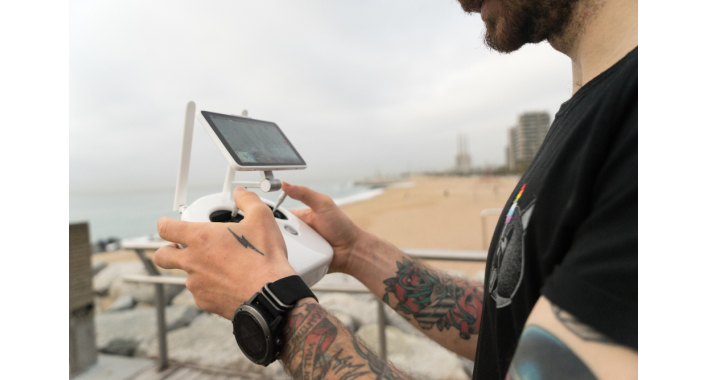
A drone can fly with ordinary satellite positioning and still look impressive on camera. It can follow a route, return home, and trace smooth arcs over a field or a construction site. But the moment you ask it to produce measurements you can defend — an elevation model for drainage design, a stockpile volume for billing, a facade survey for retrofitting — “pretty accurate” turns into a liability. Standard consumer-grade positioning is built for navigation, not evidence.
That’s why teams doing serious mapping, inspection, and automation keep coming back to one unglamorous ingredient: rtk base station corrections. It’s the difference between “the drone says it was here” and “we can prove it was here, within centimeters, repeatedly.”
Why standard GPS hits a wall in the air
Satellite navigation errors don’t politely cancel out just because your drone is well-behaved. They stack. Atmospheric delays, clock and orbit uncertainties, signal reflections, and simple geometry — the satellites aren’t always where you want them in the sky — can push position estimates around by a meter or three. For casual flying, that’s tolerable. For survey-grade deliverables, it’s how projects acquire “mystery offsets” that no one admits to causing.
Height is the first place this becomes obvious. Vertical accuracy is typically worse than horizontal, and in mapping work, vertical errors are the ones that quietly ruin drainage slopes, earthwork quantities, and “is this structure leaning?” debates. You might not notice it on a single flight. You will notice it when you repeat the mission a month later and your surface model doesn’t align with itself.
RTK in plain terms: correcting the story in real time
RTK GNSS is essentially a reality check. A reference point at a known location compares what satellites should look like versus what they actually look like at that moment, then broadcasts corrections to the moving receiver. The drone (or its controller) uses that correction stream to tighten its position estimate dramatically — often into the centimeter realm in good conditions.
The appeal isn’t only raw accuracy; it’s consistency. A drone mission is rarely a one-off event. You fly the same corridor before and after a road cut. You revisit a quarry every week. You monitor coastal erosion after storms. RTK helps make “change detection” about the terrain, not about the navigation noise of the day.
The parts people skip in marketing: what can still go wrong
RTK doesn’t abolish physics. It negotiates with it.
Signal reflections (multipath) can still trick the receiver, especially near metal structures, glassy buildings, or even water surfaces. Tree canopy can reduce satellite visibility just enough to degrade fixes. Radio links can drop corrections at the worst possible moment — typically right as you reach the key overlap area you promised your client would be clean.
And then there’s the human factor: bad setup. A reference point placed on unstable ground, a tripod that gets nudged, a coordinate system mismatch, an antenna height entered incorrectly — these are not exotic failures. They are the ordinary ways precision work becomes expensive. The irony is that RTK makes you feel confident faster, which is wonderful until it isn’t.
Good operators treat confidence as something you verify, not something you assume. They log metadata, run check points, and compare outputs against known control. The workflow is not “trust the magic,” it’s “trust, then validate.”
When drones truly need RTK: a practical list
Not every flight needs centimeter positioning. But several common drone jobs cross the line quickly.
Topographic mapping for design and earthworks
If you’re generating surfaces that will inform grading, drainage, or cut/fill calculations, the extra precision pays back immediately. It reduces the need for heavy ground control in some scenarios and improves repeatability for progress surveys.
Corridor mapping and linear infrastructure
Pipelines, roads, rail, powerlines — long skinny projects are unforgiving. Small horizontal errors can become big headaches when you mosaic outputs across kilometers.
Construction verification and as-built documentation
The question is rarely “does it look right?” It’s “is it where the plan says it is?” RTK helps align site reality with design geometry, especially when paired with sensible check points.
Repeat monitoring and “what changed?” missions
Environmental monitoring, shoreline work, landslide tracking, stockpile volumes — change detection is only meaningful if your baseline and follow-up align tightly.
Precision landing and tight automation workflows
Autonomous docking, repeatable launch/land cycles, and operations in constrained spaces benefit from better absolute positioning, especially when visual markers aren’t reliable.
RTK, PPK, and the art of not arguing about acronyms
RTK is real-time. PPK (post-processed kinematic) corrects the data after the flight using recorded observations. The practical difference is when you want certainty: during the mission or after it.
RTK is excellent when you want immediate confidence, live quality status, and fewer surprises in the field. PPK can be more forgiving when your correction link is unstable, because you can repair the solution later — assuming you logged the right data and your workflow is disciplined.
Many professional teams end up using both mindsets: real-time corrections to reduce risk, and post-processing as a backstop. The goal isn’t to win an acronym contest; it’s to deliver a map that holds up when someone overlays it on engineering drawings and asks uncomfortable questions.
GIS and photogrammetry: where precision becomes useful, not just impressive
A drone’s position estimate is not the final product. The final product is the map, model, or measurement — and it lives in a coordinate system shared with other data: parcel boundaries, utility networks, design surfaces, environmental layers.
This is where accurate positioning stops being a tech brag and starts being an operational advantage. Outputs align with existing GIS layers with less manual shifting. Repeat surveys compare cleanly. Control points become verification rather than rescue.
And the quieter benefit: teams spend less time “explaining away” small mismatches. In project meetings, that saved time is currency.
Standard GPS is fine until the day it isn’t, and that day usually arrives with a deadline attached. RTK GNSS for drones is not a luxury feature; it’s a way to make drone data behave like professional measurement rather than a very detailed guess.





It's free and takes 2 minutes. There are 1500+ digital agencies in the catalog that are ready to help in the implementation of your tasks. Choose and save up to 30% on time and budget!