
Smart Accounting Software Development: Secure, Scalable & Future-Ready
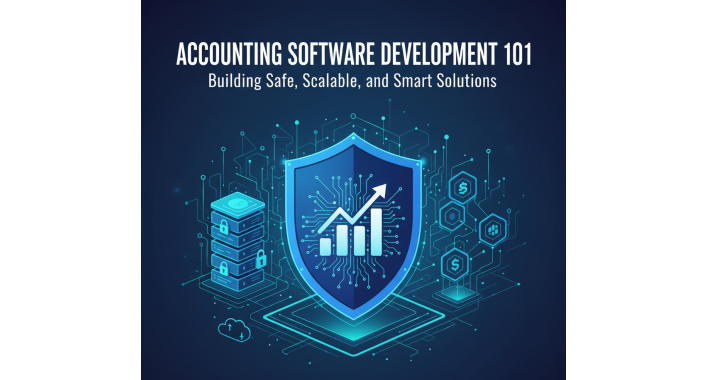
Financial management has always been the backbone of any business, but as organizations grow and transactions multiply, traditional accounting systems often fail to keep pace. Today's financial teams need more than spreadsheets and outdated tools - they require intelligent systems that automate, secure, and optimize every financial process. That's where accounting software development comes in. It empowers businesses to build tailored, tech-driven financial solutions that handle complex tasks with speed and precision.
Let's take a better look at how accounting software development is transforming current financial management through the development of safe, scalable, and intelligent platforms.
What Is Accounting Software Development?
The development of accounting software is defined as the design, development, and implementation of a tailor-made accounting software that automates and controls the financial processes of a company. In contrast to the traditional, off-the-shelf accounting software, custom accounting software is configured to fit the needs of a particular business, such as automation of payroll or tax management and real-time reporting.
A well-developed financial software system provides accuracy, scalability, and security - three critical aspects in today's data-driven economy. It goes beyond simple bookkeeping to include predictive analytics, automated reconciliation, and compliance management.
With the support of experienced accounting software developers, businesses can integrate essential tools such as ERP systems, CRM platforms, and banking APIs into a single financial ecosystem that provides a 360° view of the organization's fiscal health.
Why Businesses Need Modern Accounting Software
The process of finance management in a modern competitive environment is more than merely monitoring the revenues and costs. Companies need to guarantee the accuracy of real-time data, comply with the requirements, and uphold transparency in departments. Incidentally, due to manual processes and old tools, human error, inefficiency, and possible data breach are likely to occur.
The reason why custom accounting software has become a necessity is as follows:
- Tedious activities like invoicing, reconciliation, and payroll processing are performed automatically.
- Real-time reporting to make better decisions and manage cash flows.
- Better security of data to safeguard confidential financial data.
- Scalability and support to meet future growth requirements of the business.
- Local and international regulations compliance support.
Foresight organizations know that having a custom financial management system will result in higher efficiency, lower costs, and better business intelligence.
Key Features of Modern Accounting Software
Functionality, integration, and security are the pillars that are used to create a powerful business accounting software solution. The following are the features of accounting software requirements that can be considered as indispensable:
- Workflow Optimization and Automation — Automate monotonous financial processes like expense management, invoicing, and payroll in order to save time and reduce errors.
- Real-Time Data Analytics - Understand the financial performance via AI-based dashboards and visual reports.
- Multi-User Access Control - Allow secure role-based teamwork in finance.
- Compliance Management — Ensure compliance with such financial regulations as GAAP, IFRS, and GDPR.
- Seamless Integrations — Integrate your accounting software development with ERP, CRM, or HR to facilitate the flow of data throughout the departments.
- Cloud and Mobile Accessibility - Anywhere, secure access to financial data, which is flexible to remote teams.
- Advanced Security Measures — Protect sensitive information using encryption, firewalls, and multi-factor authentication.
The Role of AI and Automation in Accounting
The future of accounting is admittedly intelligent — it is driven by artificial intelligence and automation. AI accounting software is capable of evaluating spending patterns, identifying anomalies, and predicting financial outcomes in the future with unbelievable accuracy. In the meantime, accounting automation tools are used to automatically perform repetitive operations such as invoice matching, categorizing expenses, and bank reconciliation.
The following is the way AI and automation are smarter in accounting:
- Predictive Insights: Machine learning models forecast the cash flow and revenue patterns.
- Reduction in the number of mistakes made: Automated checks help detect and fix discrepancies in data.
- Fraud Detection: AI will identify suspicious account activity in real time.
- Smart Decision Support: Data-driven insights enable leadership to make informed financial decisions faster.
Through the use of accounting system integration, businesses will be able to make their accounting departments more of a strategic asset that will lead to growth rather than a center of cost.
Building Safe and Scalable Accounting Systems
Safety and scalability cannot be compromised as far as accounting software within an enterprise is concerned. The financial systems in businesses need to be in a position to deposit high volumes of transactions safely and effectively.
1. Safety First
The best accounting software development company will focus on security at all levels. Key safety measures include:
- End-to-end encryption to secure sensitive financial data.
- Role-based authorization to restrict unauthorized access.
- Adherence to regulations such as GDPR, SOC 2 and ISO 27001.
2. Scalability and Flexibility
The current development of financial software is related to the use of cloud-native architectures. This ensures that the system can easily scale with the expansion of the business, supporting the increase in the number of users, transactions, and data without any problems with performance.
3. Smooth System Integration
Your accounting software should make integration with existing business applications easier. The integration of the accounting system will provide uniformity in the financial information of sales, human resources, and operations, which will enhance the accuracy and efficiency of the whole system.
Custom vs. Off-the-Shelf Accounting Software
While off-the-shelf tools like QuickBooks or Xero are popular, they come with limitations in flexibility and scalability. On the other hand, custom accounting software is designed to fit your specific operational needs and compliance standards.
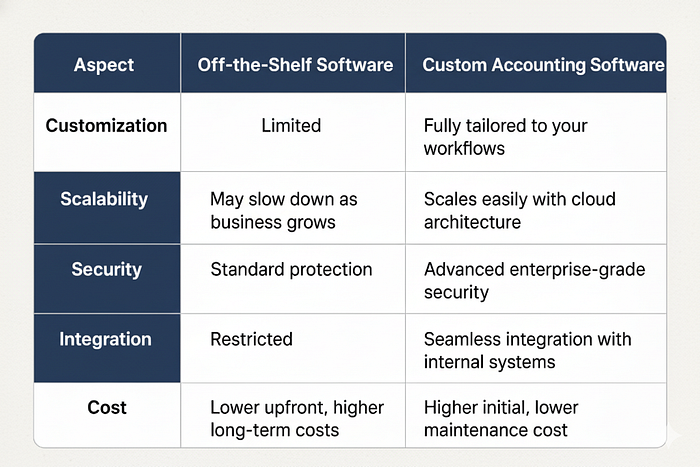
In the long run, custom accounting software development delivers better value and sustainability.
Accounting technology is changing at a very high rate. Developers of future-ready accounting software are already incorporating artificial intelligence, cloud computing, and blockchain technologies into their product.
These innovations will continue to evolve even smarter, more secure, and responsive to evolving business requirements in business accounting software.
In an era where accuracy, adherence, and safety are the main aspects of financial prosperity, investing in accounting software development is the move that all businesses may have to make. You can rely on a reliable accounting software development firm to make a safe, scalable and intelligent financial platform to meet your objectives, whether you are a small startup and need automation or an enterprise that wants to modernize your old system.
The future of accounting is not only about working with numbers but to also enable businesses to make smarter financial decisions with confidence and clarity.
The Future of Accounting Software Development
Here's what lies ahead:
Conclusion




It's free and takes 2 minutes. There are 1500+ digital agencies in the catalog that are ready to help in the implementation of your tasks. Choose and save up to 30% on time and budget!