
How to promote Sushi
We were reached by a client who had already running advertising campaigns and had previously worked with a renowned agency. However, they stopped working with the agency for internal reasons. The client is provides delivery of pizza and sushi in the city of Almaty, Kazakhstan.
It was necessary to review all events, conversions, since the site was updated a couple of times and only orders were correctly tracked, for example, clicks on a phone number, instant messengers, callbacks, etc. were not tracked.
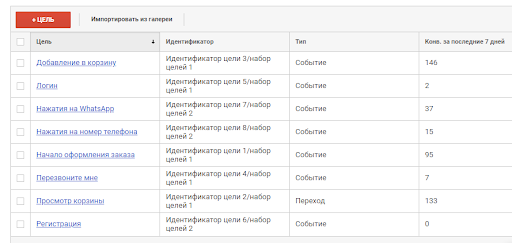
Also, the client had a second website ready for launch for the city of Bishkek, Kyrgyzstan. There, all analytics had to be set up from scratch. We installed Google Tag Manager, set up sending of all events to GA, set up goals in Google Analytics, e-commerce setup, remarketing funnel audiences (cart, payment, order + calls and chat in messengers). We calculated the value of each type of conversion, so that later Google / Yandex would better understand which conversions are more valuable, but at the same time we did not want to optimize advertising campaigns purely for online orders, since, for example, 30% of orders went through instant messengers and calls, of course, we didn’t want to loose them while optimizing advertising campaigns.
list of conversions in google analytics
The client had search campaigns set up, but almost half of the traffic went through a dynamic search campaign, and the second part went through brand search campaign. In general, this approach takes place, but we usually try to add all possible search terms to ad account, divide them into groups and gather only small search volume search terms using a dynamic search campaign.
Anyway, since there were already running ad campaigns, we started by analyzing search term reports from all campaigns for the entire period. We made a pivot table, analyzed the effectiveness, divided requests into groups, and collected negative keywords.
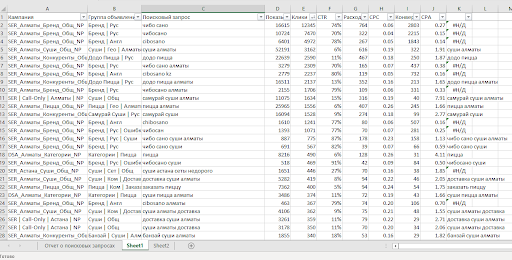
pivot table from all-time all campaigns search term report
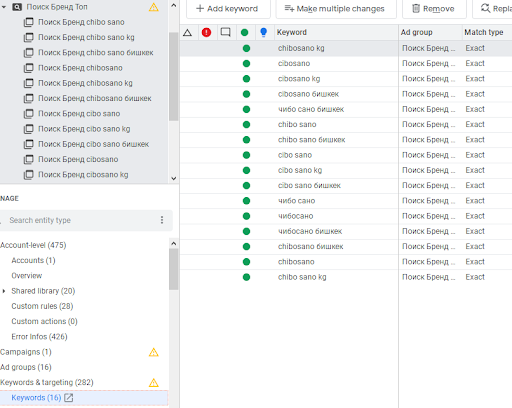
Brand queries were divided into pure brand terms variations and brand + category. This is how we got a campaign with TOP brand queries, there are 16 of them, and we made a cross negative keywords by ad groups, so that for a specific query, we can separately see the statistics and competitors that are advertising on it.
Since for these search requests we are already in 1st place in seo, and competitors rarely advertise on them, we left this campaign with a minimum budget of $1 per day and simply monitor whether someone new is being advertised. There were a couple of such cases, but we solved this issue by verbal agreements and the competitor stopped advertising on them.
top pure brand search queries
The second more interesting brand campaign was brand + categories, as well as all possible typos of brand queries. Competitors were often advertising on them, due to the fact that there were also categorical keywords and keywords similar to other queries due to typos. We manage this campaign according to the strategy for the maximum conversions, but we also allocate a minimum budget for it, but we monitor whether there are any interesting new search queries in it, if so, we add them to the main search campaign.
brand + category search campaign keywords

By all means, we have reduced half of the budget that used to be spent on advertising based on brand queries to a minimum and moved it to advertising by category keywords. Then we monitored the number of orders for organic, and everything worked as it should, we did not lose orders for the brand queries, they just moved from PPC to SEO traffic.

SEO traffic increase made from PPC
To be honest, the main category campaign we redesigned several times in order to find its optimal configuration and betting strategy. As a result, we settled on this option:
- Exact match search terms from all categories in a single campaign;
- Ad groups with dynamic targets in the same campaign;
- Search queries in phrase match type were also added to separate groups, but when they were turned on, it was understood that mostly some irrelevant or low volume queries were got there, since we collected everything in exact match, so these groups are on pause now;
- Competitor queries were also added to this campaign, since our goal does not change even with such traffic, we want to get the most out of the budget;
- We combined everything into one campaign so that there was more data for optimization and the strategy Maximum conversion value worked successfully, which takes into account both orders and clicks to the messenger, click-to-calls (based on CRM data and GA conversion, we calculated the value of each goal).

list of ad groups from the main search category campaign
After all the steps, we set up similar campaigns in Yandex Direct, but there we turned off the dynamic search campaign and auto-targeting ad group after a couple of months, since we collected all the relevant queries, and only spam began to appear there. Therefore, now only the Brand and the Category campaigns are active in Yandex.
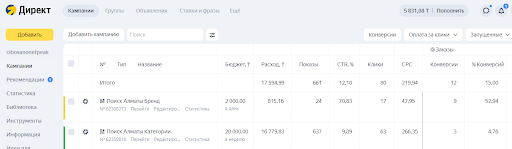
list of active Yandex PPC campaigns
As a result, according to this approach, we set up the following advertising accounts:
- Kazakhstan Google Ads;
- Kazakhstan Yandex.Direct;
- Kyrgyzstan Google Ads.
A few months later, we received record orders volume of 1,500 orders per month in Almaty and 500 in Bishkek.
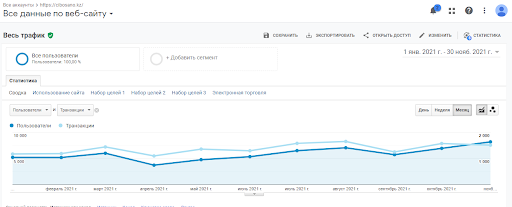
Kazakhstan traffic & orders volume month over month

Kyrgyzstan traffic & orders volume month over month
An interesting case was also with an increase of budgets by 30%. Google recommended to do this by showing graphs, they say, conversions will increase proportionally. In one month we did it, but we only got more synthetic conversions, but in fact there were no more orders, and we reduced the budget back.
Conclusions & summary:
- Make a simple structure of advertising campaigns, dividing them by the type of goal, the fewer campaigns you have, the more statistics you have for each, the better your smart strategies work.
- Collect as many keywords as possible so that at least half of your traffic goes by exact match words. It is always clear then what works and what does not, without complex analytics, poking around, downloading all data, creating pivot tables, etc.
- Trust Google, but double check, when its forecasts the more conversions or budgets increase needed, it does not always positively affect actual online orders.
- For the food delivery niche, brand awareness and repeat orders are very important. In this case, a client’s 30% of orders for both advertising and organic / direct come from current clients. Thanks to them, it turns out to keep the positive return on investment in advertising. Therefore, give maximum impact to the quality of products, service and your USP.
- Without customer returns and repeat orders, any advertising, even a well-tuned one, will give you a tangible minus in costs and will never pay for itself, since the cost of attracting a new customer and the cost of his first order will always be higher than the profit received at the first time of the profit. Only his later LTV, if the client returns, will generate a positive ROAS for you for the 1st or 2nd month of advertising.
It's free and takes 2 minutes. There are 1500+ digital agencies in the catalog that are ready to help in the implementation of your tasks. Choose and save up to 30% on time and budget!




We were reached by a client who had already running advertising campaigns and had previously worked with a renowned agency. However, they stopped working with the agency for internal reasons. The client is provides delivery of pizza and sushi in the city of Almaty, Kazakhstan.
It was necessary to review all events, conversions, since the site was updated a couple of times and only orders were correctly tracked, for example, clicks on a phone number, instant messengers, callbacks, etc. were not tracked.
Also, the client had a second website ready for launch for the city of Bishkek, Kyrgyzstan. There, all analytics had to be set up from scratch. We installed Google Tag Manager, set up sending of all events to GA, set up goals in Google Analytics, e-commerce setup, remarketing funnel audiences (cart, payment, order + calls and chat in messengers). We calculated the value of each type of conversion, so that later Google / Yandex would better understand which conversions are more valuable, but at the same time we did not want to optimize advertising campaigns purely for online orders, since, for example, 30% of orders went through instant messengers and calls, of course, we didn’t want to loose them while optimizing advertising campaigns.
list of conversions in google analytics
The client had search campaigns set up, but almost half of the traffic went through a dynamic search campaign, and the second part went through brand search campaign. In general, this approach takes place, but we usually try to add all possible search terms to ad account, divide them into groups and gather only small search volume search terms using a dynamic search campaign.
Anyway, since there were already running ad campaigns, we started by analyzing search term reports from all campaigns for the entire period. We made a pivot table, analyzed the effectiveness, divided requests into groups, and collected negative keywords.
pivot table from all-time all campaigns search term report
Brand queries were divided into pure brand terms variations and brand + category. This is how we got a campaign with TOP brand queries, there are 16 of them, and we made a cross negative keywords by ad groups, so that for a specific query, we can separately see the statistics and competitors that are advertising on it.
Since for these search requests we are already in 1st place in seo, and competitors rarely advertise on them, we left this campaign with a minimum budget of $1 per day and simply monitor whether someone new is being advertised. There were a couple of such cases, but we solved this issue by verbal agreements and the competitor stopped advertising on them.
top pure brand search queries
The second more interesting brand campaign was brand + categories, as well as all possible typos of brand queries. Competitors were often advertising on them, due to the fact that there were also categorical keywords and keywords similar to other queries due to typos. We manage this campaign according to the strategy for the maximum conversions, but we also allocate a minimum budget for it, but we monitor whether there are any interesting new search queries in it, if so, we add them to the main search campaign.
brand + category search campaign keywords
By all means, we have reduced half of the budget that used to be spent on advertising based on brand queries to a minimum and moved it to advertising by category keywords. Then we monitored the number of orders for organic, and everything worked as it should, we did not lose orders for the brand queries, they just moved from PPC to SEO traffic.
SEO traffic increase made from PPC
To be honest, the main category campaign we redesigned several times in order to find its optimal configuration and betting strategy. As a result, we settled on this option:
- Exact match search terms from all categories in a single campaign;
- Ad groups with dynamic targets in the same campaign;
- Search queries in phrase match type were also added to separate groups, but when they were turned on, it was understood that mostly some irrelevant or low volume queries were got there, since we collected everything in exact match, so these groups are on pause now;
- Competitor queries were also added to this campaign, since our goal does not change even with such traffic, we want to get the most out of the budget;
- We combined everything into one campaign so that there was more data for optimization and the strategy Maximum conversion value worked successfully, which takes into account both orders and clicks to the messenger, click-to-calls (based on CRM data and GA conversion, we calculated the value of each goal).
list of ad groups from the main search category campaign
After all the steps, we set up similar campaigns in Yandex Direct, but there we turned off the dynamic search campaign and auto-targeting ad group after a couple of months, since we collected all the relevant queries, and only spam began to appear there. Therefore, now only the Brand and the Category campaigns are active in Yandex.
list of active Yandex PPC campaigns
As a result, according to this approach, we set up the following advertising accounts:
- Kazakhstan Google Ads;
- Kazakhstan Yandex.Direct;
- Kyrgyzstan Google Ads.
A few months later, we received record orders volume of 1,500 orders per month in Almaty and 500 in Bishkek.
Kazakhstan traffic & orders volume month over month
Kyrgyzstan traffic & orders volume month over month
An interesting case was also with an increase of budgets by 30%. Google recommended to do this by showing graphs, they say, conversions will increase proportionally. In one month we did it, but we only got more synthetic conversions, but in fact there were no more orders, and we reduced the budget back.
Conclusions & summary:
- Make a simple structure of advertising campaigns, dividing them by the type of goal, the fewer campaigns you have, the more statistics you have for each, the better your smart strategies work.
- Collect as many keywords as possible so that at least half of your traffic goes by exact match words. It is always clear then what works and what does not, without complex analytics, poking around, downloading all data, creating pivot tables, etc.
- Trust Google, but double check, when its forecasts the more conversions or budgets increase needed, it does not always positively affect actual online orders.
- For the food delivery niche, brand awareness and repeat orders are very important. In this case, a client’s 30% of orders for both advertising and organic / direct come from current clients. Thanks to them, it turns out to keep the positive return on investment in advertising. Therefore, give maximum impact to the quality of products, service and your USP.
- Without customer returns and repeat orders, any advertising, even a well-tuned one, will give you a tangible minus in costs and will never pay for itself, since the cost of attracting a new customer and the cost of his first order will always be higher than the profit received at the first time of the profit. Only his later LTV, if the client returns, will generate a positive ROAS for you for the 1st or 2nd month of advertising.