
Promotion of an online store selling wristwatches
About the project
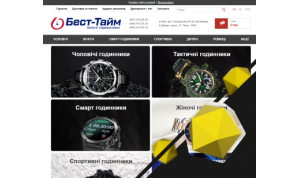
An online store selling budget and mid-range watches. Although the store focuses more on inexpensive watches, it has to compete with larger stores that sell all types of watches, from cheap to premium.
Best-Time is the official representative of many popular manufacturers, which allows it to offer the most competitive prices on the market.
Work objectives:
- Increase website visibility
- Rank in the top 3 for key queries
- Increase traffic and applications
- Increase website conversions
- Maintain current positions
Joint promotion strategy
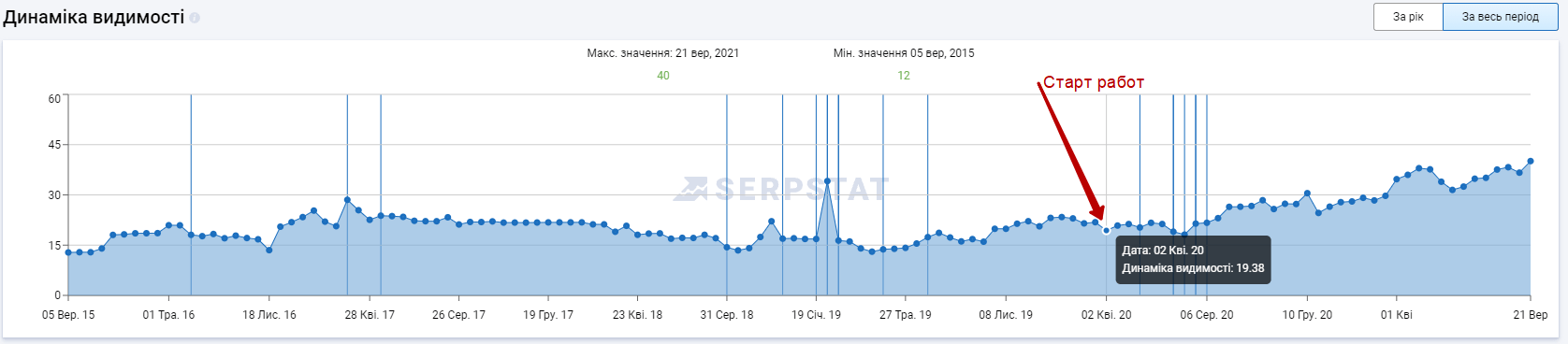
The promotion strategy for this website was quite specific, since at the time of contacting us, the website already had positions for many queries and very good traffic, but was gradually beginning to stagnate. In addition, the spring quarantine had a significant impact on the work of many businesses, and it was necessary to more actively develop sales from the website. To implement quarantine restrictions, the business did not allow for any decline in turnover.
In terms of the overall strategy, everything on the website needed to be reviewed — from technical optimization to improving usability and user interaction (UI/UX). But here it was very important to implement everything in the right order. Looking at the areas of work in general, the following was done:
- Technical optimization
- Internal anchor linking
- Semantics and page optimization for queries
- Creation of new pages for low-frequency queries.
- Updating information content and optimization for queries.
- Improving the mobile version to increase conversion
- Building up a mass of links to support and grow target keywords
What was done
Semantics
The initial stage required analyzing all currently ranked queries and correctly building a strategy for working with the site so as not to lose the current ranking for queries and only increase it.
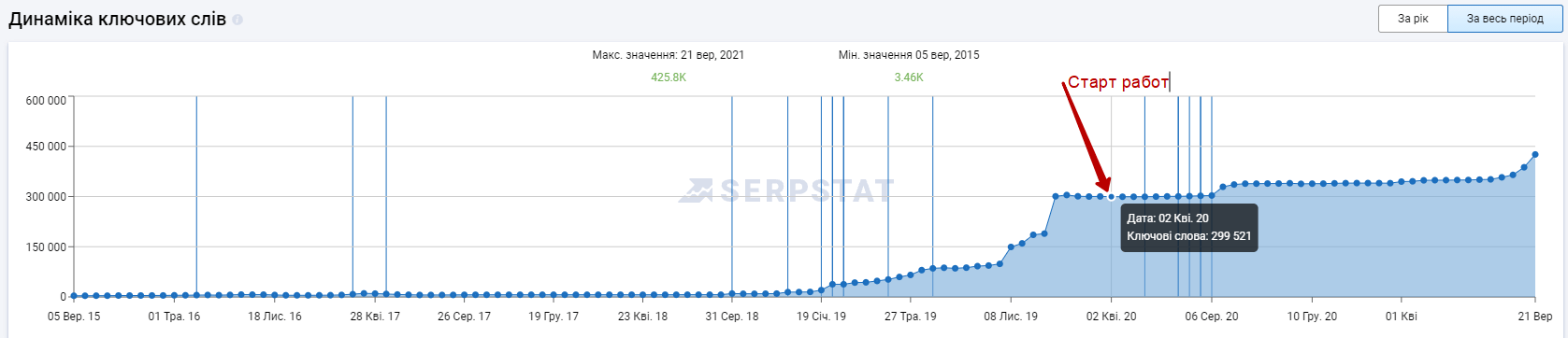
The client already had semantics that had been measured, and we had statistics on the dynamics of all measured keys.
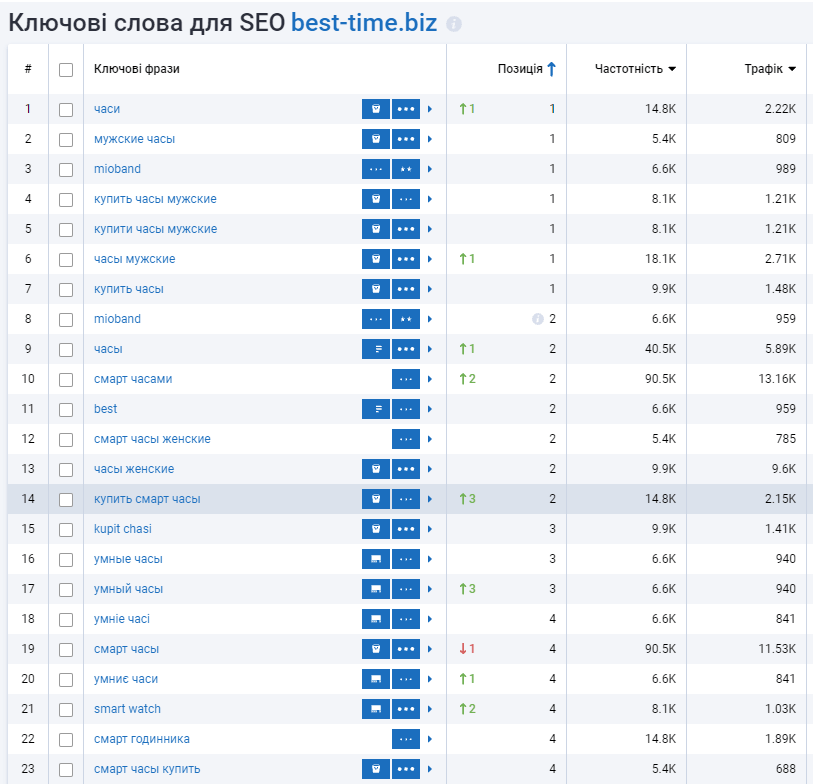
In addition, new semantics that were not measured were collected. Furthermore, by uploading the ranked keywords to Google Search Console, we found high-frequency and medium-frequency queries that generated good traffic, ranking in the top 5-10, but could generate more if they were brought up to the top 3.
After collecting all the semantics into a single file, we saw the real picture on the site.
By breaking down the semantics into groups, we measured seasonality and calculated the groups of queries that could be pulled up to the TOP to get more traffic, also due to the growth in seasonality.
In order to correctly implement this semantics on the site, it is necessary to distribute it correctly across the pages and adjust the current content. To do this, it is necessary to analyze competitors in the TOP and derive a formula for “ideal content” — text size, percentage of occurrence, water content, etc.
Content
After this analysis, some of the texts in the main categories were completely rewritten, and some were simply rewritten with optimization for occurrences. I would like to note that the thematic content of the sites was very good, and previous articles were used as a basis for new ones. Taking into account the structure of the text on each page, H2/H3 headings were written with keyword inclusion, if necessary.
The texts were also correctly formatted in terms of the presence of headings, marked and numbered lists, and internal anchor links to priority categories and sections.
The next area of work was technical and internal optimization of the site—the site loaded very slowly, there were a large number of errors in the code, language tags were incorrectly organized, and pagination was incorrectly configured. Several technical specifications were formed for the programmer, which were divided according to priority and constant control over the implementation of technical tasks.
The next step in working with the website was to optimize its indexing, as there was a discrepancy between the search results and the site map. In addition, the website had pages in Google's SuplementalIndex (Google's “snot”), which can have an extremely negative impact on indexing. An analysis of the pages in the search results was carried out using Google Webmaster. The robots.txt file was re-downloaded on the site. The principle of forming the site map was renewed. All pages with dynamic parameters and those in the index were closed with meta robots. After that, the data in the Google console was closely monitored.
Structure expansion
The next step was to expand the structure for a huge pool of low-frequency queries. This functionality could be implemented with minimal effort using a so-called SEO filter, which generates a static page with unique meta tags and content based on the technical parameters of the product. In this way, we attracted a large number of long queries with a frequency of up to 5 to the search results. For the correct indexing of such pages on the site, it was necessary to implement the functionality of internal linking to similar pages and update the formation of the site map taking these pages into account.
Also, when collecting semantics, we found long-tail queries for which new categories were created and filled with text.
All this allowed us to increase the number of useful pages on the site and in the index, so as not to lag too far behind the main competitors in the search results.
Use of micro-markups
In order to expand snippets in search results and increase their click-through rate (CTR), it was necessary to implement micro-markups. In essence, this will increase traffic even without changing the positions of queries. Several micro-markups were taken as a basis, which can expand SERP results:
- Breadcrumbs
- Product
- AgregateRating
- Review
- FAQ
Since FAQ cannot be displayed with any of the other micro-markups, a small experiment was conducted to determine which one was more effective. But after Google cut the functionality of the FAQ micro-markup, the focus on most pages was placed on AgregateRating and Product.
USABILITY + conversions
Since the site design was quite old, and updating it completely could lead to a drop in rankings, etc., it was decided to analyze the usability of the site both on desktop and separately with a focus on the mobile version. An analysis of competitors was conducted
- for the presence of functionality that increases conversion;
- the site's shortcomings that could lead to lost orders
- the structure of competitors' page blocks and their implementation on mobile-responsive pages.
Based on this analysis, a huge technical assignment was formed with various options for solving issues and problems. Since the client is a business owner and independently manages the context + could conduct some experiments and trials on his own, he has an understanding of how the target audience interacts with the website. A meeting was organized, based on which points for implementation were identified.
This made it possible to improve interaction with the site and optimize the site's display on mobile devices.
Link to profile
Since the niche is very competitive and we have to compete with sites that are at least twice as large in terms of products and number of internal pages, links are one of the points of growth for the site and support for queries in the TOP. Most importantly, it was necessary to analyze the current link profile of the site, identify low-quality external links, and remove them through Google. Then it was necessary to analyze the anchor text of the links, the distribution of pages, compare them with the average value for the niche, and work on increasing links with as small a budget as possible.
For this site, there was a lot of work with platforms that are not available on exchanges – outreach. This was done in order to get good links from thematic or near-thematic platforms for a reasonable price.
After analyzing the current link site and all major competitors in the search results, a link building strategy was developed. With a monthly selection of anchors, platforms, text writing, and the purchase of crowd links, to diversify anchor text and combine do/nofollow.
City pages
Since Google is increasingly starting to work with regional search results and even substitute site pages with region specifications for general queries. This is especially relevant for sites that have offline offices in different cities. After analyzing events from general queries in Kharkiv (where there is an office), 60% go to the regional page.

It's free and takes 2 minutes. There are 1500+ digital agencies in the catalog that are ready to help in the implementation of your tasks. Choose and save up to 30% on time and budget!



About the project
An online store selling budget and mid-range watches. Although the store focuses more on inexpensive watches, it has to compete with larger stores that sell all types of watches, from cheap to premium.
Best-Time is the official representative of many popular manufacturers, which allows it to offer the most competitive prices on the market.
Work objectives:
- Increase website visibility
- Rank in the top 3 for key queries
- Increase traffic and applications
- Increase website conversions
- Maintain current positions
Joint promotion strategy
The promotion strategy for this website was quite specific, since at the time of contacting us, the website already had positions for many queries and very good traffic, but was gradually beginning to stagnate. In addition, the spring quarantine had a significant impact on the work of many businesses, and it was necessary to more actively develop sales from the website. To implement quarantine restrictions, the business did not allow for any decline in turnover.
In terms of the overall strategy, everything on the website needed to be reviewed — from technical optimization to improving usability and user interaction (UI/UX). But here it was very important to implement everything in the right order. Looking at the areas of work in general, the following was done:
- Technical optimization
- Internal anchor linking
- Semantics and page optimization for queries
- Creation of new pages for low-frequency queries.
- Updating information content and optimization for queries.
- Improving the mobile version to increase conversion
- Building up a mass of links to support and grow target keywords
What was done
Semantics
The initial stage required analyzing all currently ranked queries and correctly building a strategy for working with the site so as not to lose the current ranking for queries and only increase it.
The client already had semantics that had been measured, and we had statistics on the dynamics of all measured keys.
In addition, new semantics that were not measured were collected. Furthermore, by uploading the ranked keywords to Google Search Console, we found high-frequency and medium-frequency queries that generated good traffic, ranking in the top 5-10, but could generate more if they were brought up to the top 3.
After collecting all the semantics into a single file, we saw the real picture on the site.
By breaking down the semantics into groups, we measured seasonality and calculated the groups of queries that could be pulled up to the TOP to get more traffic, also due to the growth in seasonality.
In order to correctly implement this semantics on the site, it is necessary to distribute it correctly across the pages and adjust the current content. To do this, it is necessary to analyze competitors in the TOP and derive a formula for “ideal content” — text size, percentage of occurrence, water content, etc.
Content
After this analysis, some of the texts in the main categories were completely rewritten, and some were simply rewritten with optimization for occurrences. I would like to note that the thematic content of the sites was very good, and previous articles were used as a basis for new ones. Taking into account the structure of the text on each page, H2/H3 headings were written with keyword inclusion, if necessary.
The texts were also correctly formatted in terms of the presence of headings, marked and numbered lists, and internal anchor links to priority categories and sections.
The next area of work was technical and internal optimization of the site—the site loaded very slowly, there were a large number of errors in the code, language tags were incorrectly organized, and pagination was incorrectly configured. Several technical specifications were formed for the programmer, which were divided according to priority and constant control over the implementation of technical tasks.
The next step in working with the website was to optimize its indexing, as there was a discrepancy between the search results and the site map. In addition, the website had pages in Google's SuplementalIndex (Google's “snot”), which can have an extremely negative impact on indexing. An analysis of the pages in the search results was carried out using Google Webmaster. The robots.txt file was re-downloaded on the site. The principle of forming the site map was renewed. All pages with dynamic parameters and those in the index were closed with meta robots. After that, the data in the Google console was closely monitored.
Structure expansion
The next step was to expand the structure for a huge pool of low-frequency queries. This functionality could be implemented with minimal effort using a so-called SEO filter, which generates a static page with unique meta tags and content based on the technical parameters of the product. In this way, we attracted a large number of long queries with a frequency of up to 5 to the search results. For the correct indexing of such pages on the site, it was necessary to implement the functionality of internal linking to similar pages and update the formation of the site map taking these pages into account.
Also, when collecting semantics, we found long-tail queries for which new categories were created and filled with text.
All this allowed us to increase the number of useful pages on the site and in the index, so as not to lag too far behind the main competitors in the search results.
Use of micro-markups
In order to expand snippets in search results and increase their click-through rate (CTR), it was necessary to implement micro-markups. In essence, this will increase traffic even without changing the positions of queries. Several micro-markups were taken as a basis, which can expand SERP results:
- Breadcrumbs
- Product
- AgregateRating
- Review
- FAQ
Since FAQ cannot be displayed with any of the other micro-markups, a small experiment was conducted to determine which one was more effective. But after Google cut the functionality of the FAQ micro-markup, the focus on most pages was placed on AgregateRating and Product.
USABILITY + conversions
Since the site design was quite old, and updating it completely could lead to a drop in rankings, etc., it was decided to analyze the usability of the site both on desktop and separately with a focus on the mobile version. An analysis of competitors was conducted
- for the presence of functionality that increases conversion;
- the site's shortcomings that could lead to lost orders
- the structure of competitors' page blocks and their implementation on mobile-responsive pages.
Based on this analysis, a huge technical assignment was formed with various options for solving issues and problems. Since the client is a business owner and independently manages the context + could conduct some experiments and trials on his own, he has an understanding of how the target audience interacts with the website. A meeting was organized, based on which points for implementation were identified.
This made it possible to improve interaction with the site and optimize the site's display on mobile devices.
Link to profile
Since the niche is very competitive and we have to compete with sites that are at least twice as large in terms of products and number of internal pages, links are one of the points of growth for the site and support for queries in the TOP. Most importantly, it was necessary to analyze the current link profile of the site, identify low-quality external links, and remove them through Google. Then it was necessary to analyze the anchor text of the links, the distribution of pages, compare them with the average value for the niche, and work on increasing links with as small a budget as possible.
For this site, there was a lot of work with platforms that are not available on exchanges – outreach. This was done in order to get good links from thematic or near-thematic platforms for a reasonable price.
After analyzing the current link site and all major competitors in the search results, a link building strategy was developed. With a monthly selection of anchors, platforms, text writing, and the purchase of crowd links, to diversify anchor text and combine do/nofollow.
City pages
Since Google is increasingly starting to work with regional search results and even substitute site pages with region specifications for general queries. This is especially relevant for sites that have offline offices in different cities. After analyzing events from general queries in Kharkiv (where there is an office), 60% go to the regional page.