
In-App Community vs Discord: A Practical Buyer’s Guide
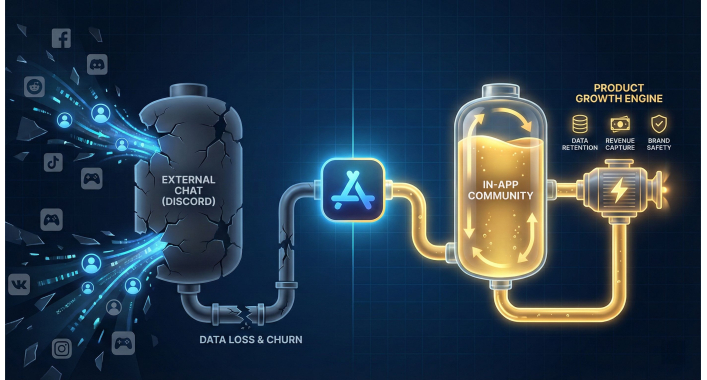
Over the last couple of years, the easiest way to create a digital community has been to set up a Discord server instead of building an in app community. No programming skills, no special setup, and everything happens outside the app. But as the community grows, this setup often turns into a “leaky bucket” for the product.
When you invite a user into a messenger outside the app, you are not just giving them a place to talk. You are giving away data, user retention and part of the monetisation pie.
The Comparison: At a Glance
Discord and External Messengers vs In-App Community
User journey
-
External chat interrupts the user journey and pulls people out of the app.
-
An in-app community keeps the journey in one place: users stay in the app, watching, browsing and engaging.
Data ownership
-
External chat works like a “data black hole”: it is hard to link chat activity to real user profiles.
-
An in-app community gives full data ownership and lets you connect profiles with community activity
Monetisation
-
It is difficult to monetise the conversation flow directly.
-
An in-app community gives you tools to offer related items, upsells and promotional
-
content when people are already active.
Safety
-
External communities are open, so competitors and spammers can easily enter the space.
-
An in-app community is private, with AI-powered moderation tools and clear rules.
After the quick comparison, it’s worth looking at what actually changes when your community lives outside the product. Below are the four areas where teams feel the difference first - retention, infrastructure, revenue and safety.
1. The Hidden Cost of “Free” Platforms
The biggest hidden cost of using Discord and similar tools is the “leaky bucket” effect on retention.
When a user clicks a link and joins a third-party community, they are immediately hit by notifications from friends, games and other brands. The chances that they will go back to the app, finish the intended action or simply continue their journey inside your product drop sharply.
2. Infrastructure: Build vs Buy vs Embed
When someone in the company says “let’s build our own chat”, most people picture a long road: WebSockets, scaling, uptime, moderation tools, mobile releases and so on.
In practice there are three main options:
-
The build option. Total control, but a lot of work: real-time delivery, storage, moderation, dashboards and a team to support it all.
-
The Discord option. Easy to start and mostly free to run, but the community lives on someone else’s platform and follows someone else’s roadmap.
-
The Watchers option. A WebView-based social layer that can be embedded into the existing app. The community UI and moderation rules are updated on the server side, so small fixes and changes do not depend on App Store reviews or new SDK versions.
3. Turning Talk into Revenue
A community inside your product should not just be noise. There are clear benefits when the conversation happens inside the product rather than outside:
-
Copy dealing. Users share actions they take in the product — buying a membership, backing an offer, following a tip — and others can copy these actions with one click.
-
Integrated marketing. Promotions and messages can appear directly in the chat at the moment when users are most engaged.
-
AI gamification. Badges and levels are tied to real behaviour in the community, not just to how long someone has had an account.
This is how the social layer becomes a working community tool, not just a background chat.
4. Safety and Brand Protection
External groups have permeable boundaries. Competitors, affiliates, spam bots and scammers can quickly enter a Discord or Telegram space and pull users away.
When the social layer is contained inside the app, the platform has tools to keep the space under control:
-
multi-layer AI moderation that detects toxicity, spam and obvious fraud in milliseconds;
-
automatic masking of phone numbers, emails and payment details in public rooms;
-
a private environment that is easier to show to leagues, sponsors and partners.
Hosting the primary in-app chat and community that can interact in it helps turn attention into something that can be measured and monetised. Instead of renting an audience in third-party chats, an in-app social layer helps the app shift from a one-time solution to a destination people return to — where the value created by the community stays with the product.





It's free and takes 2 minutes. There are 1500+ digital agencies in the catalog that are ready to help in the implementation of your tasks. Choose and save up to 30% on time and budget!